Skip to content
This Kenya Safari Safety Guide explains the practical precautions travelers should understand before beginning a safari. The purpose is not to make Kenya sound dangerous. It is to help travelers distinguish ordinary safari precautions from unnecessary fear and prepare appropriately for wildlife, road travel, accommodation, health, cities and remote areas.
A safari in Kenya can be one of the most memorable travel experiences in Africa. Watching elephants cross the plains of Amboseli, following lions across the Maasai Mara, seeing rhinos at Lake Nakuru or exploring the enormous wilderness of Tsavo creates memories that can last a lifetime. However, wildlife encounters, unfamiliar roads, remote destinations and new environments make preparation important.
Kenya has a long-established tourism industry and an extensive network of national parks, reserves, conservancies, safari camps, lodges and professional guides. Most well-organized safaris follow established routes and procedures designed to protect visitors and wildlife.
Still, safari takes place in natural environments. Lions are not zoo animals. Elephants decide where they want to walk. Buffalo can be unpredictable. Roads inside national parks can become rough, dusty or muddy. Some camps are located far from major towns and hospitals.
Safety therefore depends heavily on preparation, responsible behavior and choosing professional service providers.
The most useful rule in this Kenya Safari Safety Guide is remarkably simple: listen to experienced guides and park authorities. They understand the environment and can recognize situations that visitors may not.
The following guide covers wildlife encounters, game drives, accommodation, transportation, self-driving, walking safaris, children, senior travelers, solo travel, photography, health precautions, food and water, emergencies and the common mistakes that can turn an otherwise excellent safari into an unnecessary problem.
Kenya Safari Safety Guide for First-Time Visitors
First-time visitors sometimes imagine safari as a dangerous expedition into completely uncontrolled wilderness.
A professionally organized safari is much more structured.
Most game viewing takes place from vehicles. Travelers stay in established camps or lodges. Professional guides understand local wildlife behavior, park regulations and road conditions.
The important thing is not to become careless simply because everything feels comfortable.
A lion sleeping beside a safari vehicle remains a wild predator.
An elephant feeding peacefully can become defensive if a vehicle blocks its path.
A buffalo grazing near a camp should never be approached.
Safety begins by respecting that you are visiting the animals’ environment.
When your guide asks you to remain seated, lower your voice, stay inside the vehicle or wait before leaving an area, follow the instruction immediately.
Is Kenya Safe for Safari?
This is one of the most common questions asked by first-time travelers.
There is no meaningful way to describe an entire country or every possible trip as completely risk-free. Kenya combines established tourism areas with regions that may carry different security conditions, and official travel advisories can change.
The major safari circuits around destinations such as Maasai Mara, Amboseli, Lake Nakuru, Samburu and Tsavo receive large numbers of visitors and have established tourism infrastructure.
The safest approach is to separate safari-specific risks from general travel risks.
Inside parks and reserves, the main considerations are wildlife behavior, vehicle safety, road conditions and following park regulations.
In cities and during transfers, travelers should use ordinary precautions regarding belongings, transportation and personal security.
Before traveling, visitors should also check current official travel advice applicable to their nationality and itinerary.
Kenya Safari Safety Guide for Wildlife Encounters
Wildlife is the reason most people travel to Kenya, but it is also the reason safari rules exist.
Never treat wild animals as if they are accustomed pets.
Animals may tolerate safari vehicles because they encounter them regularly, but this does not mean they have become domesticated.
Avoid sudden movements, loud noises and attempts to attract an animal’s attention for photographs.
Do not whistle, clap, shout or imitate animal sounds.
Never ask a guide to drive dangerously close simply because you want a better photograph.
A responsible wildlife encounter allows the animal to continue its natural behavior without being surrounded, chased or disturbed.
The best photographs often come from patience rather than proximity.
Kenya Safari Safety Rules During Game Drives
Most safari accidents are preventable when visitors follow basic instructions.
Stay inside the vehicle unless your guide tells you that leaving is permitted.
Do not suddenly open doors near wildlife.
Keep children supervised.
Avoid hanging arms or legs outside the vehicle near animals.
Keep voices low when observing sensitive wildlife.
Never feed animals.
Do not throw rubbish from the vehicle.
Follow designated roads and park regulations.
The Kenya Wildlife Service emphasizes remaining inside vehicles except in designated areas, driving slowly, keeping to established roads and giving wildlife appropriate space.
These rules protect both people and animals.
Kenya Safari Safety Guide for Lions
Lions are among the animals visitors most want to see.
They may appear remarkably relaxed around safari vehicles.
A pride can sleep beside a road while several vehicles watch nearby.
Do not interpret this tolerance as permission to behave casually.
Remain inside the vehicle.
Do not attempt to touch an animal even if it approaches closely.
Keep your voice low.
Avoid sudden movements.
Never leave the vehicle for a photograph.
Your guide will decide whether the vehicle should remain still, move away or reposition.
Young lions may sometimes show curiosity toward vehicles, but curiosity should never be encouraged through food, sounds or movement.
Observe and allow the animal to control the encounter.
Kenya Safari Safety Around Elephants
Elephants are intelligent, social and fascinating animals.
They also deserve considerable space.
A professional guide watches elephant body language carefully.
An elephant may become uncomfortable if a vehicle blocks its route, separates family members or approaches calves too closely.
Do not ask your driver to move closer when the guide is deliberately keeping distance.
Remain calm if elephants approach the vehicle.
Avoid shouting or sudden movements.
Let your guide manage the situation.
Sometimes the safest action is simply to remain still and allow the herd to pass.
Watching elephants calmly move around your vehicle can become one of the most memorable experiences of your safari.
Kenya Safari Safety Around Buffalo
Buffalo deserve particular respect.
They may appear calm while grazing, but visitors should never approach them on foot without appropriate professional guidance.
This is particularly important around camps and lodges.
Wildlife can move through unfenced safari properties, especially after dark.
Never assume that the pathway between your room and restaurant is clear simply because you walked it safely during daylight.
Where a lodge provides nighttime escorts, use them.
The escort system exists because staff understand local animal movements.
Kenya Safari Safety Around Hippos
Hippos spend much of the day in or near water, but they can travel over land at night.
This matters at lodges and camps near rivers and lakes.
Never walk between a hippo and the water.
Do not approach grazing hippos on foot.
If accommodation staff tell you that hippos frequently move through the property after dark, take the warning seriously.
Use camp escorts.
Keep doors properly closed.
Avoid walking alone along riverbanks at night.
A photograph is never worth approaching wildlife outside controlled viewing situations.
Kenya Safari Safety Around Rhinos
Kenya offers opportunities to see both black and white rhinos in selected protected areas.
Rhinos should be observed quietly and from appropriate distances.
Never attempt to approach one on foot unless participating in an officially managed activity with qualified professionals.
Follow guide instructions during vehicle encounters.
A rhino may change direction quickly.
Allow the animal room to move naturally rather than positioning the vehicle directly in its path.
Kenya Safari Safety Around Leopards and Cheetahs
Leopards and cheetahs generate excitement because sightings can be less predictable.
When one is found, several safari vehicles may gather.
Do not pressure your guide to join a chaotic vehicle crowd.
Responsible guides maintain space and position vehicles without blocking animals.
Predators may be hunting, feeding or caring for young.
Interfering with that behavior can negatively affect their survival.
Keep quiet and allow the animal to behave naturally.
A relaxed leopard resting in a tree for twenty minutes provides a far better experience than a stressed animal surrounded by noisy vehicles.
Kenya Safari Safety Guide for Maasai Mara
The Maasai Mara is one of Kenya’s most famous wildlife destinations and receives significant visitor numbers.
Wildlife encounters can sometimes attract many safari vehicles, especially during busy periods.
Choose an experienced guide who respects reserve rules and animal welfare.
Avoid encouraging aggressive driving to reach sightings.
Stay inside the vehicle except in authorized locations.
During migration periods, river crossings can create particularly busy viewing conditions.
Wildlife should always have enough space to move.
The objective is to observe migration behavior, not influence it.
Visitors should also remember that the Maasai Mara is a functioning ecosystem throughout the year, not simply a migration venue.
Kenya Safari Safety Guide for Amboseli
Amboseli is famous for elephants and views toward Mount Kilimanjaro.
Wildlife often moves across open areas and roads.
Give animals right of way.
Elephant herds may cross directly in front of vehicles.
Remain patient.
Never attempt to drive through a herd.
Dust can also reduce visibility on dry roads.
Drivers should maintain sensible speeds and distance from other vehicles.
During wet periods, some tracks can become muddy.
An experienced guide understands which routes are appropriate for current conditions.
Kenya Safari Safety at Lake Nakuru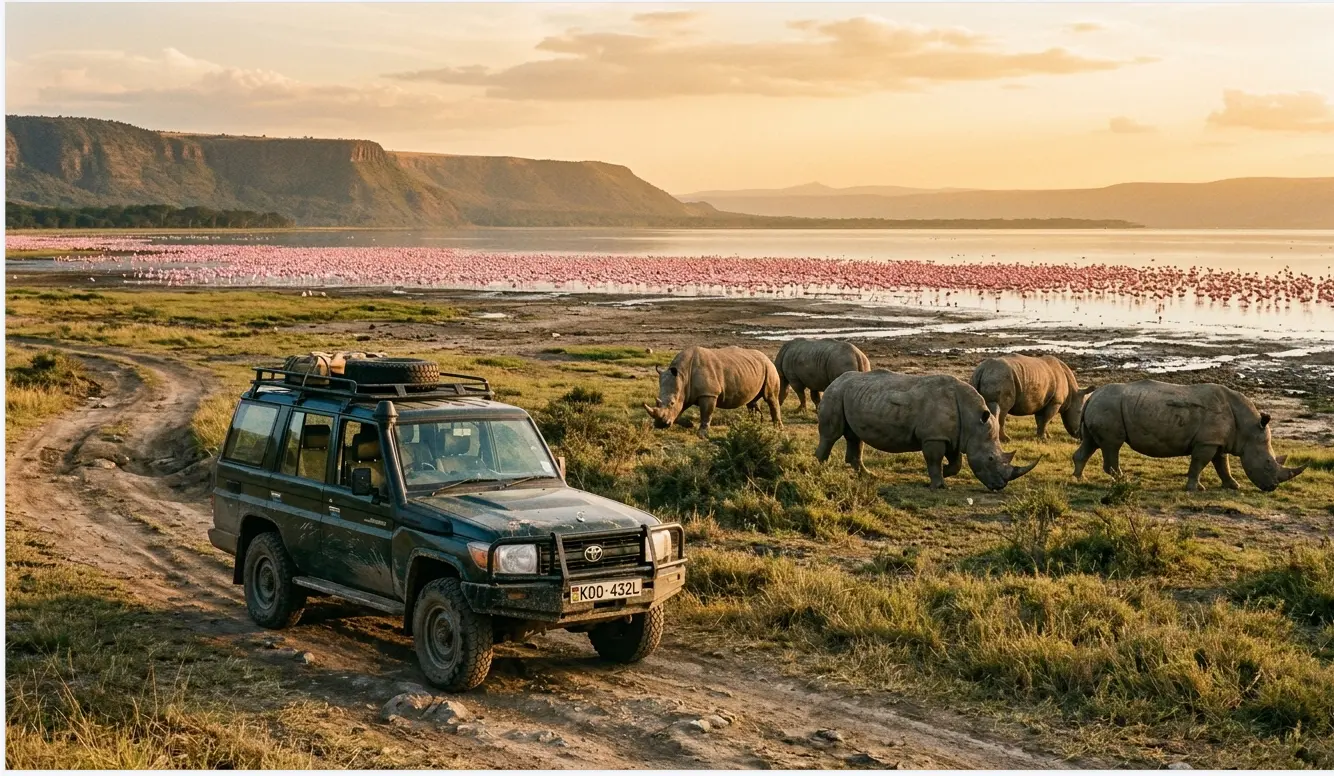
Lake Nakuru National Park offers wildlife viewing within a relatively compact area.
Rhinos are an important attraction, along with birds and other mammals.
Follow standard park regulations and remain in the vehicle except at authorized locations.
Weather can change road conditions.
After heavy rain, tracks may become slippery.
Do not pressure a driver to attempt a route simply because another vehicle has used it.
Professional drivers assess their vehicle, road conditions and weather before proceeding.
Kenya Safari Safety Guide for Samburu
Samburu’s hotter and drier environment creates different practical considerations.
Hydration becomes particularly important.
Carry sufficient drinking water during game drives.
Use sunscreen and protective clothing.
The region’s landscapes can feel remote, so travelers should plan transfers carefully and use reliable vehicles.
Follow guide instructions around rivers and wildlife.
Do not wander away from camps or designated areas without permission.
Remote landscapes are part of Samburu’s attraction, but remoteness also makes good planning more important.
Kenya Safari Safety Guide for Tsavo
Tsavo East and Tsavo West cover enormous wilderness areas.
Distances can be substantial.
Carry enough water and ensure the vehicle has sufficient fuel.
A reliable safari vehicle is particularly important.
Wildlife may be more spread out than in smaller reserves, which can encourage inexperienced drivers to rush between sightings.
Do not speed.
Safari is not a competition.
Vehicle accidents pose a much more immediate risk than failing to see another lion.
Enjoy the landscape and let wildlife encounters develop naturally.
Kenya Safari Safety at Nairobi National Park
Nairobi National Park offers genuine wildlife viewing close to the capital.
Do not treat it like an ordinary urban attraction simply because Nairobi’s skyline can be visible from parts of the park.
The animals remain wild.
Stay inside your vehicle except in designated areas.
Follow speed limits.
Keep appropriate distance from wildlife.
Avoid feeding animals.
Respect park opening and closing times.
A morning safari here can be an excellent introduction to Kenya before traveling farther into the country.
Kenya Safari Safety Guide for Safari Vehicles
The condition and operation of your safari vehicle matter.
Before a long journey, reputable operators should maintain their vehicles and prepare them for the planned route.
Passengers should use seat belts where provided and remain seated when road conditions require it.
Safari roads can be rough.
Standing through a pop-up roof while the vehicle is moving quickly over uneven terrain can result in injury.
Listen to the driver.
If the road becomes rough, sit down and secure cameras and other loose equipment.
Do not distract the driver during difficult sections.
Vehicle safety deserves as much attention as wildlife safety.
Seat Belts on Kenya Safari Vehicles
Use seat belts whenever they are available and practical.
Long transfers may involve paved highways, traffic and normal road risks.
Inside parks, tracks can contain potholes, rocks, erosion channels and sudden dips.
A driver may also need to brake unexpectedly if wildlife crosses the road.
Do not assume slow safari driving eliminates the value of a seat belt.
Children should be appropriately secured according to their age, vehicle configuration and applicable requirements.
Discuss child seating with your operator before arrival.
Kenya Safari Road Safety
Road travel is a major part of many Kenyan safaris.
Distances between Nairobi and wildlife destinations can be significant.
Choose an operator that prioritizes sensible driving over unrealistic transfer schedules.
Avoid itineraries requiring drivers to race from one park to another.
Allow sufficient travel time.
Night driving should be minimized where practical, especially on unfamiliar rural routes.
Traffic, pedestrians, motorcycles, livestock and road conditions can make nighttime journeys more demanding.
A well-designed safari itinerary reduces unnecessary road pressure.
Kenya Self-Drive Safari Safety Guide
Self-driving gives travelers independence but also transfers responsibility from a professional guide to the traveler.
Understand your route before departure.
Choose a vehicle appropriate for the terrain.
Monitor fuel.
Carry drinking water.
Know the park gate times.
Avoid attempting unfamiliar tracks simply because your navigation application shows a road.
Digital maps do not always communicate road quality.
Ask park staff about current conditions.
During rainy periods, a road that was straightforward yesterday may be difficult today.
Never underestimate mud.
Four-wheel drive improves capability but does not make a vehicle impossible to get stuck.
Kenya Safari Safety Guide for Driving in Rain
Rain can transform safari tracks quickly.
Slow down.
Increase following distance.
Avoid deep water unless you know the crossing is safe.
Do not follow another vehicle blindly through flooded sections.
If you are unsure, turn around or ask local authorities.
Mud can reduce steering and braking effectiveness.
The goal is not to prove what your 4×4 can do.
The goal is to complete your safari safely.
Experienced drivers know that turning back can sometimes be the best decision.
Kenya Safari Safety at Lodges and Tented Camps
Safari accommodation may be located directly inside wildlife areas.
Some camps are unfenced.
This is part of their attraction, but it means wildlife may move nearby.
Listen carefully during the arrival briefing.
Staff will explain whether you can walk alone after dark and how to request an escort.
Keep doors or tent zips properly closed.
Do not store food in your room unless the property says it is acceptable.
Monkeys and other animals can quickly learn where visitors keep snacks.
Never feed wildlife around accommodation.
Feeding creates dangerous habits and can ultimately harm the animal.
Kenya Safari Safety Guide for Unfenced Camps
An unfenced camp allows animals to move naturally through the surrounding ecosystem.
This does not mean visitors are left unprotected.
Professional camps use staff procedures, escorts and monitoring to manage guest movement.
At night, follow escort requirements.
Do not walk to another tent alone because the distance looks short.
Use a flashlight, but remember that light does not make approaching wildlife safe.
If you see an animal outside your room, remain inside and contact staff rather than attempting to pass it.
The camp team understands the environment better than you do.
Kenya Safari Safety at Night
Night changes the safari environment.
Animals that were inactive during daylight may begin moving.
Visibility is limited.
Do not wander around camps without permission.
Use escorts where provided.
Keep a flashlight accessible in your room.
Know how to contact reception or camp staff.
If you hear animals outside your tent, remain calm.
Safari camps are designed for this environment.
Hearing lions, hyenas or hippos during the night can be thrilling, but there is no reason to leave your room to investigate.
Kenya Safari Safety Guide for Night Game Drives
Night drives are available in certain conservancies and other authorized areas.
They should be conducted with qualified guides under local regulations.
Remain seated and follow instructions.
Avoid shining personal lights directly at animals unless your guide permits it.
Night wildlife can react differently from animals observed during daylight.
Professional guides know how to use spotlights responsibly and recognize species behavior.
Never attempt an unauthorized night drive in a national park.
Kenya Safari Safety Guide for Walking Safaris
Walking safaris require a different level of awareness because you no longer have a vehicle around you.
Only participate in properly organized walks with qualified guides or rangers where walking is permitted.
Listen carefully during the safety briefing.
Walk in the formation requested by your guide.
Keep voices low.
Do not run.
Do not move ahead of the guide.
If wildlife is encountered, follow instructions immediately.
Your guide may ask you to stop, remain silent, move slowly or change direction.
Walking safaris can be extraordinary because they reveal tracks, plants, insects and details easily missed from vehicles, but discipline is essential.
Kenya Safari Safety During Boat Safaris
Boat experiences may be available around lakes and waterways.
Wear a life jacket where required or provided.
Follow instructions from the boat crew.
Remain seated when requested.
Do not reach toward hippos, crocodiles or other wildlife.
Maintain appropriate distance.
Never encourage a boat operator to move dangerously close for photography.
Water-based wildlife viewing should be calm and controlled.
Kenya Safari Safety Guide for Photography
Photography can create unexpected safety problems when travelers become so focused on a camera that they stop paying attention to their surroundings.
Listen to your guide even while photographing.
Do not lean dangerously outside the vehicle.
Secure heavy cameras when driving over rough tracks.
Avoid changing lenses while the vehicle is moving.
Never leave a safe position to obtain a better angle.
Do not ask guides to violate park regulations for photographs.
No photograph is worth putting yourself, your guide or wildlife at risk.
Kenya Safari Safety for Drone Users
Do not assume you can launch a drone because you are in an open landscape.
Protected areas have regulations concerning aircraft and drones.
Flying equipment can disturb wildlife and may require specific authorization.
Check current rules before bringing a drone into a park or reserve.
Never launch one near animals without permission.
Responsible wildlife photography prioritizes the animal over the image.
Kenya Safari Health and Safety Guide
Health preparation should begin before departure.
Travelers should obtain advice appropriate to their nationality, medical history, destinations and travel dates.
Requirements and recommendations can change.
Discuss vaccinations, malaria prevention and personal medications with an appropriate healthcare professional before traveling.
Bring enough prescription medication for the entire trip, plus a reasonable reserve where possible.
Keep essential medication in hand luggage rather than checked baggage.
Carry a simple personal first-aid kit for minor issues.
Travel insurance with appropriate medical coverage is strongly recommended.
Malaria and Kenya Safari Safety
Malaria risk varies by location, altitude and other factors.
Travelers should seek current medical advice about prevention appropriate to their itinerary.
Preventing mosquito bites remains useful regardless of whether medication is recommended.
Use insect repellent.
Wear appropriate clothing during periods of mosquito activity.
Use mosquito nets where supplied.
Keep accommodation screens and doors properly closed.
Do not make medical decisions based solely on travel blogs.
Individual health advice should come from qualified medical professionals.
Kenya Safari Safety and Vaccinations
Vaccination requirements and recommendations depend on factors such as nationality, previous travel, route and countries visited before or after Kenya.
Check official health information before departure.
Do this early.
Some vaccinations require time to become effective or may involve multiple doses.
Keep relevant vaccination documentation accessible when required.
Travelers combining several East African countries should check the requirements for the complete itinerary rather than Kenya alone.
Kenya Safari Food Safety
Established safari lodges and camps regularly serve international guests and generally have established food-handling procedures.
Travelers should still use sensible precautions.
Inform accommodation providers about allergies before arrival.
Do not wait until dinner to reveal a severe food allergy.
When eating outside established tourism properties, choose food that appears freshly prepared and properly cooked.
Wash or sanitize hands before meals.
Carry snacks for long transfers if needed.
Travelers with sensitive stomachs may want to introduce unfamiliar foods gradually.
Drinking Water on Kenya Safari
Hydration is essential.
Warm safari destinations can cause travelers to lose more fluid than they realize.
Use safe drinking water provided by your lodge, camp or safari operator.
Carry water during game drives.
Do not wait until you feel extremely thirsty.
Travelers should be particularly attentive to hydration during hot days, walking activities and long road transfers.
Reusable bottles can reduce waste where safe refill stations are available.
Kenya Safari Safety Guide for Sun and Heat
The African sun can be strong even when the air feels comfortable.
Use sunscreen.
Wear a hat.
Bring sunglasses.
Drink water regularly.
Long game drives can expose travelers to several hours of sunlight through open roofs and windows.
People sometimes underestimate exposure because the moving vehicle creates a breeze.
Children and older travelers may require additional attention during hot periods.
Schedule rest when needed.
Safari should be enjoyable, not an endurance test.
Kenya Safari Safety in Cold Mornings
Kenya is not always hot.
Early morning game drives can be surprisingly cold, particularly at higher elevations and in open vehicles.
Dress in layers.
A light jacket or fleece can make sunrise drives considerably more comfortable.
Cold passengers become distracted and may not enjoy the experience.
As temperatures rise, layers can be removed.
Packing for safari means preparing for temperature variation rather than simply packing for heat.
Kenya Safari Safety Guide for Families
Kenya can be a rewarding family safari destination.
The key is designing the trip around children’s ages and needs.
Avoid excessively long game drives.
Include rest periods.
Choose accommodation that accepts children of the relevant ages and provides suitable room arrangements.
Discuss child seats with the operator before arrival.
Supervise children constantly around wildlife areas.
Do not allow children to wander around camp alone.
Teach them before the first game drive that animals should not be called, fed or approached.
A good guide can turn safari into an extraordinary learning experience for children.
Kenya Safari Safety Guide for Young Children
Young children require closer supervision.
They may not understand why they need to remain quiet when an elephant approaches.
Explain safari rules before entering the park.
Bring familiar snacks, sun protection and sufficient water.
Choose shorter game drives where possible.
Avoid itineraries involving endless road transfers.
Parents should also check age restrictions for walking safaris and other specialized activities before booking.
A safari designed for adults is not automatically appropriate for a five-year-old.
Kenya Safari Safety Guide for Senior Travelers
Safari can work very well for older travelers because much of the wildlife viewing takes place from vehicles.
However, mobility needs should be discussed in advance.
High-clearance Land Cruisers can be difficult to enter.
Ask whether a step can be provided.
Choose accommodation with easy room access when required.
Avoid itineraries with excessive road travel.
If a traveler uses medication, carry enough for the entire journey.
Travel insurance and emergency medical coverage become particularly important in remote areas.
A slower itinerary can often improve both comfort and enjoyment.
Kenya Safari Safety for Travelers with Limited Mobility
Tell your safari operator about mobility requirements before booking.
This allows the company to select suitable vehicles, rooms and activities.
Some camps have long pathways, stairs or uneven ground.
Others provide rooms close to common areas.
Walking safaris may not be appropriate, but game drives can still provide excellent wildlife experiences.
The earlier accessibility needs are communicated, the easier they are to accommodate.
Kenya Safari Safety Guide for Solo Travelers
Solo travelers can enjoy Kenya without needing to join a large group.
However, planning matters.
Use established accommodation.
Arrange airport transfers in advance where practical.
Share your itinerary with someone you trust.
Keep communication available.
Avoid walking alone late at night in unfamiliar urban areas.
On safari, follow the same wildlife rules as everyone else.
Joining a small group safari can reduce costs while providing companionship.
A private safari offers greater flexibility but normally costs more because one traveler covers the vehicle and guide expenses.
Kenya Safari Safety Guide for Solo Female Travelers
Women traveling alone should apply sensible precautions without assuming that solo travel is automatically unsafe.
Arrange reliable transportation.
Choose established hotels and safari camps.
Avoid isolated urban areas at night.
Keep valuables discreet.
Communicate your itinerary to trusted contacts.
During safari, professional guides and camp staff provide the structure around daily activities.
Ask questions before booking.
Who will collect you from the airport?
Will the same guide remain with you throughout the safari?
How are nighttime escorts handled at camp?
Clear answers help you evaluate the professionalism of the operator.
Kenya Safari Safety Guide for Couples
Couples often choose private safaris because they provide flexibility and privacy.
The same safety rules apply.
Do not wander away from camps together simply because you are not alone.
Two untrained visitors are not safer around wildlife than one.
Follow escort procedures.
Keep valuables secured.
Tell camp staff if you plan to leave the property.
For honeymoon safaris, remote accommodation can be romantic, but the remoteness makes reliable transportation and communication even more important.
Kenya Safari Safety for Group Travelers
Groups should agree to follow guide instructions.
One person ignoring rules can create problems for everyone.
Do not pressure the driver to speed because the group is late.
Do not encourage someone to leave the vehicle for a photograph.
Keep track of departure times.
Large groups should also ensure luggage does not block exits or create unsafe vehicle conditions.
Safari safety is shared responsibility.
Kenya Safari Safety Guide for Nairobi
Many safaris begin or end in Nairobi.
The city should be approached as a major international urban center rather than as part of the wildlife safari environment.
Use reputable taxis, hotel transfers or verified ride-hailing services.
Keep expensive jewelry and electronics discreet in crowded public places.
Avoid carrying unnecessarily large amounts of cash.
Ask your hotel or safari operator for current local advice.
Avoid walking alone late at night in unfamiliar areas.
Plan airport transfers ahead of time, particularly for late arrivals.
Kenya Safari Airport Transfer Safety
After a long international flight, travelers can be tired and less attentive.
Prearranging airport collection simplifies arrival.
Confirm the driver’s name or contact details before traveling.
Use the meeting procedure provided by your hotel or safari company.
Do not hand luggage to an unknown person simply because they claim to be your driver.
If something seems unclear, contact the operator before leaving the airport area.
Keep your passport and essential valuables with you rather than placing them in easily accessible exterior luggage compartments.
Kenya Safari Safety Guide for Money and Valuables
Avoid carrying more cash than necessary.
Use hotel or lodge safes where appropriate.
Keep passport copies separate from the original.
Carry backup payment options.
Do not display expensive jewelry unnecessarily.
Cameras are naturally visible on safari, but they should be stored discreetly during urban transfers when not being used.
Keep your phone secure in crowded areas.
Losing travel documents or money may not be physically dangerous, but it can seriously disrupt a safari.
Kenya Safari Safety and Passport Protection
Keep your passport secure.
A digital copy stored securely can be useful.
Carry a photocopy when appropriate and keep the original protected.
Check passport validity and entry requirements before departure.
Do not leave travel-document checks until the airport.
Entry rules can change, so travelers should verify current requirements through official sources close to their departure date.
Kenya Safari Safety Guide for Travel Insurance
Travel insurance is an important part of safari planning.
Choose coverage appropriate to your itinerary.
Medical treatment and evacuation from remote destinations can be expensive.
Check whether the policy covers safari activities you intend to undertake.
If you plan walking safaris, hiking, hot-air ballooning or other specialized experiences, verify coverage.
Read exclusions.
A cheap policy is not useful if it excludes the activities you actually booked.
Keep insurance contact details accessible during the trip.
Medical Evacuation on Kenya Safari
Remote safari destinations may be several hours from advanced medical facilities.
This is why medical evacuation coverage deserves attention.
Ask your insurer how evacuation works.
Understand who needs to authorize it.
Keep your policy number available.
Your safari operator should also know how to contact appropriate emergency services from the areas included in your itinerary.
The goal is not to expect an emergency but to know what to do if one occurs.
Kenya Safari Safety Guide for Emergency Planning
Save important contacts before leaving home.
Keep your safari operator’s emergency number accessible.
Know how to contact your accommodation.
Keep insurance details available offline.
Carry identification.
If traveling independently, share your route with someone you trust.
Do not rely entirely on cloud storage because mobile data may be unavailable in remote areas.
A simple printed or offline copy of essential information can be valuable.
Mobile Phone and Connectivity Safety
Mobile coverage is available in many parts of Kenya but should not be assumed everywhere.
Remote wildlife areas may have weak or intermittent service.
Download essential travel information before leaving cities.
Save maps for offline use.
Carry a charged power bank.
Do not drain your entire battery photographing wildlife if the phone is also your primary communication device.
At camp, ask where the strongest signal is available if needed.
Kenya Safari Safety Guide for Charging Electronics
Bring appropriate charging equipment.
Some safari camps operate generators or solar systems and may provide electricity only during certain hours.
Charge cameras, phones and power banks whenever electricity is available.
Do not overload sockets with unsuitable adapters.
Keep batteries protected from excessive heat.
A dead camera is disappointing; a dead phone can also become a communication problem.
Kenya Safari Safety During the Great Migration
Migration season can create crowded conditions around major wildlife events.
River crossings attract vehicles and visitors.
Choose guides who prioritize responsible positioning.
Do not encourage drivers to block animal routes.
Stay inside the vehicle.
Be patient.
A crossing may not happen simply because animals have reached the river.
They can wait, turn around or move elsewhere.
Wildlife determines the schedule.
Trying to force the experience creates unnecessary pressure on animals and drivers.
Kenya Safari Safety Guide for Hot-Air Balloon Safaris
Balloon safaris should be booked through established providers operating according to applicable requirements.
Follow the pilot’s safety briefing carefully.
Pay attention to landing instructions.
Wear practical clothing and footwear.
Tell the operator about relevant mobility concerns before booking.
Weather determines whether balloon flights operate.
A cancellation for unsafe weather is a sign that safety procedures are working, not a reason to pressure the company to fly.
Kenya Safari Safety During Cultural Visits
Cultural experiences can add depth to a safari.
Visit communities respectfully.
Use established arrangements through reputable operators or community programs.
Ask before photographing people.
Do not photograph children without appropriate permission.
Avoid treating communities as safari exhibits.
Follow local guidance regarding dress, behavior and culturally sensitive areas.
Responsible cultural tourism protects both visitors and host communities.
Kenya Safari Safety Guide for Camping
Camping places travelers closer to the natural environment.
Use designated campsites.
Follow instructions about food storage.
Never leave food scraps around camp.
Keep tents properly closed.
Do not walk away from camp after dark without understanding local wildlife conditions.
Extinguish fires completely.
Keep shoes inside or check them before putting them on.
Listen to campsite staff.
In wildlife areas, a tent is accommodation, not a barrier that gives you permission to ignore animal movements outside.
Kenya Safari Safety for Rooftop-Tent Travelers
Rooftop tents are increasingly popular with self-drive travelers.
Park on stable, level ground.
Make sure the ladder is correctly positioned.
Do not set up in unauthorized areas.
Understand whether wildlife moves through the campsite.
Store food appropriately.
Close the tent properly before sleeping.
Do not leave shoes, food or rubbish scattered around.
When camping inside wildlife regions, follow the same rules as any other visitor.
Being elevated above the ground does not eliminate wildlife risk.
Kenya Safari Safety Guide for Drinking Alcohol
Enjoying a drink at a safari lodge can be part of a holiday, but alcohol and wildlife require sensible separation.
Do not become intoxicated before walking through an unfenced camp.
Follow escort procedures even if the restaurant is close to your room.
Never drive after drinking.
Do not approach wildlife because alcohol has reduced your judgment.
Hydrate properly, especially in hot climates.
A safari environment rewards awareness.
Kenya Safari Safety and Responsible Tourism
Safety and conservation are closely connected.
Giving wildlife adequate space reduces dangerous encounters.
Staying on authorized roads protects habitat.
Not feeding animals prevents them from becoming dependent on people.
Keeping noise low reduces stress.
Following speed limits protects wildlife and passengers.
Responsible travelers help maintain the conditions that make safaris possible.
Your behavior matters even when nobody appears to be watching.
Kenya Safari Safety Guide for Choosing a Tour Operator
Your safari company influences nearly every part of your journey.
Ask detailed questions before paying.
What vehicle will be used?
Is the safari private or shared?
Who is responsible for the guide?
What happens if the vehicle breaks down?
How are emergencies handled?
Which accommodation has been booked?
What insurance is included?
A professional operator should answer clearly.
Be cautious of quotations that are dramatically cheaper without explaining what has been removed.
Safety, vehicle maintenance, qualified staff and reliable logistics cost money.
Value is more important than simply finding the lowest price.
Checking Your Kenya Safari Vehicle
You do not need to perform a mechanical inspection yourself, but basic awareness helps.
Look at the general condition of the vehicle.
Seat belts should function where provided.
Doors should close properly.
Luggage should be secured.
The vehicle should carry appropriate spare-wheel and basic recovery equipment for its route.
If something feels unsafe, ask.
Professional operators should not be offended by reasonable safety questions.
Kenya Safari Safety Guide for Choosing Accommodation
Location and operational standards matter as much as room appearance.
Read recent reviews.
Ask whether the camp is fenced or unfenced.
Find out how guests move around after dark.
If you have mobility needs, ask about pathways.
Families should confirm room configurations.
Solo travelers may want rooms reasonably close to common areas.
Travelers with medical conditions should consider distance from major facilities.
The most beautiful remote camp is not automatically the right choice for every traveler.
Kenya Safari Safety Mistakes to Avoid
The first major mistake is ignoring your guide.
The second is treating wildlife like animals in a zoo.
Another is rushing between destinations and forcing drivers into unrealistic schedules.
Travelers also create unnecessary problems by walking alone after dark at unfenced camps, carrying excessive cash, using unknown transportation, leaving food accessible to animals or failing to purchase suitable insurance.
Overconfidence is particularly dangerous.
After several peaceful game drives, visitors may begin thinking safari rules are unnecessarily strict.
They are not.
The reason many safaris proceed smoothly is precisely because professional operators and travelers follow established procedures.
What to Do if an Animal Approaches Your Safari Vehicle
Remain calm.
Do not make sudden movements.
Do not shout.
Do not attempt to touch the animal.
Follow your guide.
An elephant may cross beside the vehicle.
A lion may lie in the shade created by the car.
A curious cheetah may approach.
Your guide understands how to respond.
The safest action for passengers is usually to remain quiet and allow the professional to manage the situation.
What to Do if Your Safari Vehicle Breaks Down
Stay with the vehicle unless your guide tells you otherwise.
Do not begin walking through a wildlife area looking for help.
Professional safari operators should have communication and support procedures.
The guide can contact the company, park authorities or another vehicle when required.
Carry water.
Remain patient.
Mechanical problems are inconvenient, but leaving the protection of the vehicle can turn an inconvenience into a safety issue.
What to Do if You Feel Unwell on Safari
Tell your guide or lodge staff early.
Do not wait until a minor problem becomes serious.
Dehydration, stomach problems, allergies and other illnesses can worsen if ignored.
Your operator can help determine what medical facilities are available nearby.
For serious symptoms, professional medical advice should be sought promptly.
Keep insurance information and medication details accessible.
Kenya Safari Safety Guide FAQs
Is Kenya safe for safari tourists?
Kenya has long-established safari circuits and tourism infrastructure, but no destination is risk-free. Travelers should use reputable operators, follow park rules, monitor current travel advice and take normal personal-security precautions.
Are lions dangerous on safari?
Lions are wild predators. Visitors should remain inside safari vehicles and follow guide instructions. Responsible viewing allows lions adequate space and avoids disturbing them.
Can lions attack safari vehicles?
Wild animals can behave unpredictably, which is why professional guides maintain appropriate positioning and visitors should follow instructions. Do not leave the vehicle or attempt to interact with predators.
Is it safe to see elephants from a safari vehicle?
Elephant viewing is a standard safari experience when conducted responsibly. Give elephants space and allow your guide to interpret their behavior.
Can I leave the vehicle during a game drive?
Only leave in designated areas or when your guide or park authority confirms that it is permitted.
Is the Maasai Mara safe for tourists?
The Maasai Mara has extensive safari infrastructure. Visitors should follow reserve regulations, use reputable operators and apply the same wildlife precautions used elsewhere.
Is Amboseli safe for safari?
Amboseli is an established safari destination. Wildlife rules, responsible driving and guide instructions should always be followed.
Is Tsavo safe for safari?
Tsavo is a major safari destination, but its enormous size and remote sections make vehicle preparation, fuel, water and sensible route planning especially important.
Is Nairobi National Park safe?
Visitors should follow Kenya Wildlife Service park regulations, remain in vehicles except at designated locations and respect wildlife distances.
Is Kenya safe for solo travelers?
Solo travel is possible with appropriate planning. Use reputable accommodation and transportation, keep trusted contacts informed and follow current local advice.
Is Kenya safe for solo female travelers?
Women travel independently in Kenya, but sensible precautions are important. Arrange reliable transfers, avoid isolated urban areas after dark and choose established safari operators and accommodation.
Is Kenya safari safe for children?
Family safaris are common. Children require close supervision, suitable vehicle arrangements and itineraries designed around their ages.
Is Kenya safari suitable for seniors?
Yes, many safari activities involve vehicle-based wildlife viewing. Travelers should communicate mobility and medical requirements before booking.
Is it safe to stay in tented safari camps?
Established tented camps operate specifically in wildlife environments. Follow camp instructions, particularly regarding nighttime movement and food storage.
Can animals enter safari camps?
Wildlife may move through unfenced camps. This is why many properties provide escorts after dark and detailed arrival briefings.
Is a walking safari safe?
Walking safaris should only be undertaken where permitted and with appropriately qualified professional guides or rangers.
Is self-driving in Kenya’s national parks safe?
It can be done with proper preparation, an appropriate vehicle and knowledge of park regulations and current road conditions.
Should I drive at night in Kenya?
Unnecessary night driving is best minimized, particularly on unfamiliar rural routes. Plan transfers so that major journeys can be completed during daylight where practical.
Do I need travel insurance for a Kenya safari?
Travel insurance with appropriate medical and evacuation coverage is strongly recommended for safari travel, particularly because some wildlife destinations are remote.
What should I do during a wildlife emergency?
Follow your guide or ranger immediately. Do not improvise, run or attempt to solve the situation yourself.
Should I carry a first-aid kit?
A small personal first-aid kit is useful for minor issues, although it does not replace professional medical care.
Can I feed animals during safari?
No. Feeding wildlife can change natural behavior and create dangerous dependence on people.
How close can safari vehicles get to wildlife?
Visitors should maintain responsible distances according to park regulations and guide instructions. The Kenya Wildlife Service publishes a recommended minimum viewing distance of 20 meters in its park guidance.
Should I use a seat belt in a safari vehicle?
Use seat belts where available, particularly during road transfers and whenever road conditions make sudden movement possible.
Are safari lodges secure?
Standards vary. Choose established accommodation and follow each property’s security and wildlife procedures.
What is the most important Kenya safari safety rule?
Follow the instructions of professional guides, rangers and camp staff. They understand the local environment, wildlife behavior and operating procedures.
Final Kenya Safari Safety Guide Advice
Safari safety does not require spending your holiday worrying about everything that could go wrong.
It requires preparation and respect.
Choose a professional safari company.
Use a suitable vehicle.
Follow your guide.
Respect wildlife.
Remain inside the vehicle when required.
Use camp escorts after dark when instructed.
Keep hydrated.
Prepare for sun, heat, cold mornings and changing weather.
Purchase appropriate travel insurance.
Check current official travel and health information before departure.
Most importantly, never allow excitement to override judgment.
Seeing a lion five meters closer is not worth disturbing the animal.
A photograph is not worth leaving a safe vehicle.
Arriving thirty minutes earlier is not worth speeding on a rough road.
The best safari experiences usually happen when travelers slow down and allow nature to set the pace.
This Kenya Safari Safety Guide should therefore be viewed as preparation rather than a reason for concern. When travelers understand the environment and follow professional guidance, they can concentrate on what brought them to Kenya in the first place: extraordinary wildlife, vast landscapes and the experience of seeing animals living freely in their natural habitat.
Plan Your Trip with Our Kenya Safari Safety Guide
Universal Ventures Rwanda helps travelers plan customized East African journeys combining wildlife safaris, private transportation, gorilla trekking, chimpanzee trekking, cultural experiences and multi-country adventures.
A Kenya safari can also be combined with Rwanda for mountain gorilla trekking, Akagera National Park, Lake Kivu and other experiences. Travelers with additional time can create broader East African itineraries connecting Kenya, Rwanda and Uganda.
Good safari planning starts before arrival. Share your travel dates, number of travelers, preferred destinations, accommodation level and activities so that the itinerary can be designed around realistic travel times and your priorities.
For more information about safari planning and customized East African travel, contact:
Universal Ventures Rwanda
Email: info@universalventuresrwanda.com
Phone / WhatsApp: +250 781 441 853
Address: Kigali, Rwanda