Skip to content
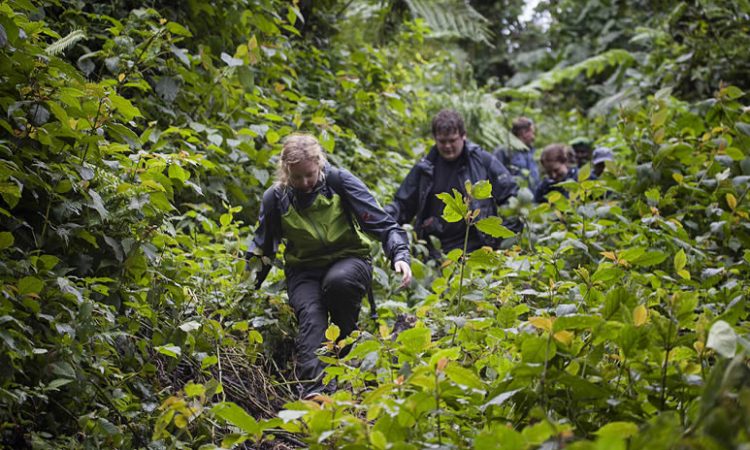
Gorilla trekking in Uganda is one of Africa’s most powerful wildlife experiences. Deep inside the mountain forests of Bwindi Impenetrable National Park and Mgahinga Gorilla National Park, visitors can walk through ancient vegetation to meet a habituated mountain gorilla family.
However, every visitor needs a valid permit before joining a trek. Understanding the price, booking procedure, visitor categories and permit conditions is therefore essential.
This Uganda Gorilla Permit Price Guide explains how much a Uganda gorilla permit costs, what the fee includes, where permits are valid and how far ahead you should book. It also covers discounted low-season permits, the Gorilla Habituation Experience, cancellation rules, trekking sectors and the complete cost of planning a Uganda gorilla safari.
As of August 2026, the standard Uganda gorilla trekking permit costs USD 800 per foreign non-resident. Uganda has also introduced a discounted rate of USD 600 for foreign non-residents trekking during April, May or November. These official low-season discounts can reduce the cost of a gorilla safari, especially for couples, families and small groups.
Permit rates and conditions can change. Therefore, travelers should always confirm availability and the applicable tariff before paying. Uganda Wildlife Authority, commonly called UWA, is the government body responsible for issuing permits and managing Uganda’s national parks. Uganda Wildlife Authority’s official tariff page publishes the latest notices and conservation rates.
Uganda Gorilla Permit Price Guide: Quick Rate Summary
The amount you pay depends on your nationality or residency category. Uganda Wildlife Authority separates visitors into foreign non-residents, foreign residents, citizens of other African countries and East African citizens.
Standard Uganda gorilla permit prices
| Visitor category | Standard permit price per person | Low-season price |
|---|---|---|
| Foreign non-resident | USD 800 | USD 600 |
| Foreign resident | USD 700 | USD 500 |
| Rest of Africa citizen | USD 500 | Confirm when booking |
| East African citizen | UGX 300,000 | Confirm when booking |
| Gorilla Habituation Experience – foreign non-resident | USD 1,500 in 2026 | No standard discount |
| Gorilla Habituation Experience – foreign resident | USD 1,000 under the 2024–2026 tariff | Confirm current applicable rate |
| Gorilla Habituation Experience – Rest of Africa | USD 1,000 | Confirm when booking |
| Gorilla Habituation Experience – East African citizen | UGX 750,000 | Confirm when booking |
The USD 600 and USD 500 promotional rates apply to qualifying treks in April, May and November. The low-season permits are generally non-reschedulable. Travelers should therefore finalize their flights and safari dates before purchasing one.
The official 2024–2026 UWA tariff lists standard gorilla permits at USD 800 for foreign non-residents, USD 700 for foreign residents, USD 500 for other African citizens and UGX 300,000 for East African citizens. It also states that the fee includes the guide, park entrance for the trekking day and a community development contribution. See the official UWA conservation tariff.
UWA has also published revised 2026–2027 information. Because implementation dates and promotional conditions may differ by activity, anyone booking travel in late 2026 or 2027 should request written confirmation of the applicable price before making payment. View UWA’s 2026–2027 tariff update.
What Is a Uganda Gorilla Trekking Permit?
A Uganda gorilla trekking permit is an official authorization allowing one person to join a guided mountain gorilla trek on a specified date. The permit is connected to a particular park and, in Bwindi, normally to a particular trekking sector.
A standard permit gives the visitor an opportunity to:
- Enter the assigned gorilla trekking park on the booked date.
- Attend the mandatory pre-trek briefing.
- Trek with Uganda Wildlife Authority guides and trackers.
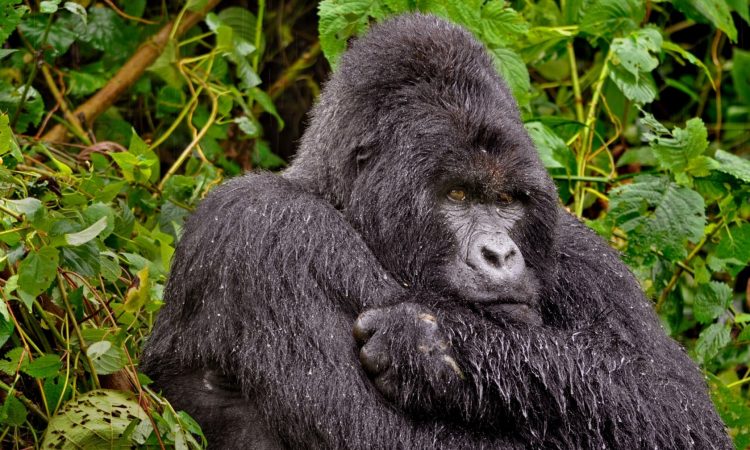
- Visit one habituated mountain gorilla family.
- Spend up to one hour observing the gorillas after finding them.
- Contribute directly to conservation and surrounding communities.
A permit is issued to an individual traveler. It cannot simply be shared between two people. Every participant must have a valid permit and present identification matching the booking information.
The permit is not the same as a complete gorilla safari package. It provides access to the regulated trekking experience, while the rest of the journey must be arranged separately.
How Much Is a Uganda Gorilla Permit in 2026?
For most international tourists, the answer is straightforward: a standard Uganda gorilla permit costs USD 800 per person.
This foreign non-resident category normally applies to visitors who live outside Uganda and do not hold qualifying residency in an East African country.
Uganda low-season gorilla permit price
During April, May and November, qualifying foreign non-residents can pay USD 600 per person. Foreign residents can pay USD 500 per person.
A couple booking the USD 600 promotional rate saves USD 400:
- Standard price for two people: USD 1,600
- Low-season price for two people: USD 1,200
- Total saving: USD 400
A group of six foreign non-residents can save USD 1,200:
- Standard price for six: USD 4,800
- Low-season price for six: USD 3,600
- Total saving: USD 1,200
Nevertheless, discounted permits usually carry stricter conditions. In particular, low-season permits cannot normally be moved to another date. That makes them most suitable for travelers with confirmed flights and a stable itinerary.
Uganda Gorilla Permit Price Guide for 2027
Travelers planning a safari in 2027 should distinguish between standard gorilla trekking and the Gorilla Habituation Experience.
The revised UWA schedule keeps the standard gorilla tracking price at the familiar tariff levels, including USD 800 for foreign non-residents. However, the Gorilla Habituation Experience is listed at higher future prices, including USD 1,800 for foreign non-residents and USD 1,600 for foreign residents.
Because tariff implementation can involve specific effective dates, promotional periods and booking conditions, obtain a written quotation before confirming a 2027 trip.
Your quotation should state:
- The exact trekking date.
- The national park and Bwindi sector.
- The visitor category.
- The permit price.
- Any processing or bank charges.
- The payment deadline.
- The cancellation and rescheduling conditions.
- Whether the permit has already been issued.
This approach protects your budget and prevents misunderstandings if official rates change between the planning stage and the payment date.
Who Qualifies for Each Uganda Gorilla Permit Rate?
The visitor categories sometimes cause confusion. A traveler’s nationality, passport and residency documents determine the correct rate.
Foreign non-residents
Foreign non-residents include most international tourists who do not live in Uganda or another qualifying East African country.
Examples can include visitors from:
- The United States
- Canada
- The United Kingdom
- Germany
- France
- Spain
- Italy
- Australia
- New Zealand
- China
- Japan
- India
The standard rate is USD 800 per person. The qualifying promotional rate is USD 600 during April, May and November.
Foreign residents
A foreign resident is normally a non-citizen who legally resides in Uganda or another qualifying East African country. A visitor cannot receive this rate merely because they are staying in the region for several weeks.
UWA may request:
- A valid passport.
- A current work permit.
- A residency permit.
- Other proof of legal residence.
The standard foreign-resident gorilla trekking permit is USD 700. The promotional low-season price is USD 500 for eligible dates.
Rest of Africa citizens
The Rest of Africa category applies to passport holders from African countries outside the qualifying East African citizen group. The standard tariff has listed the gorilla trekking permit at USD 500 per person.
Travelers must present a valid African passport. Residence in an African country without citizenship may not be enough.
East African citizens
East African citizens benefit from a regional tariff, commonly listed at UGX 300,000 per person for a standard gorilla trek.
Eligible travelers should confirm the current list of recognized East African Community nationalities when booking. They must also provide a valid national passport or accepted identity document.
A residence permit is not the same as citizenship. Foreign residents should therefore use the foreign-resident category unless UWA confirms otherwise.
What Does a Uganda Gorilla Permit Include?
According to the official tariff, a standard Uganda gorilla permit includes the ranger guide fee, entrance to the park for the trekking day and a community development contribution.
More practically, the fee covers the regulated services required to conduct the trek safely.
Pre-trek briefing
Every trek begins with a briefing at the assigned park headquarters. UWA staff explain forest conditions, gorilla behavior, safety rules and responsible viewing practices.
Ranger guides and trackers
Experienced trackers begin monitoring gorilla movements before visitors enter the forest. Ranger guides then lead each trekking group and communicate with the advance tracking team.
One hour with a habituated gorilla family
Once the trekking group reaches the gorillas, the standard viewing period is up to one hour. This limit reduces pressure on the animals while allowing visitors to observe feeding, resting, communication and family interactions.
Park entrance on the trekking day
The standard permit includes entrance to Bwindi Impenetrable National Park or Mgahinga Gorilla National Park for the booked gorilla trekking activity.
Conservation support
Permit revenue supports important conservation work, including:
- Ranger operations.
- Habitat monitoring.
- Veterinary interventions.
- Anti-poaching work.
- Gorilla research.
- Community conservation.
- Management of protected areas.
- Visitor safety and trekking infrastructure.
Community contribution
A portion of tourism revenue supports communities living around Uganda’s protected areas. Community-based conservation is important because people living beside gorilla habitat face both opportunities and costs associated with wildlife protection.
What Is Not Included in the Uganda Gorilla Permit Price?
The permit is only one part of the overall trip. It normally does not include the following services.
Transportation

Travelers must arrange transport to their allocated Bwindi sector or to Mgahinga Gorilla National Park. The journey may begin in Entebbe, Kampala, Kigali, Queen Elizabeth National Park or another safari destination.
A proper safari vehicle is strongly recommended. Roads near the parks can be steep, rough or slippery, particularly during rainy periods.
Accommodation
The permit does not include a hotel or lodge. You need accommodation close to the correct trekking headquarters.
This detail matters because Bwindi has four sectors that are separated by long and sometimes difficult roads. Booking a lodge in the wrong sector can result in a stressful early transfer or even a missed briefing.
Meals and Meals drinking water
Breakfast, packed lunch, dinner and drinking water are not included unless they form part of your lodge or safari package.
Most lodges prepare packed lunches for trekking guests. A typical packed lunch includes sandwiches, fruit, snacks, juice and water.
Porter services
Porters are hired separately on the morning of the trek. A porter can carry your backpack, packed lunch, water and camera equipment. Porters also provide valuable support on steep or muddy sections.
Hiring a porter directly benefits local households. Therefore, it is recommended even for reasonably fit travelers.
Tips
Tips for guides, trackers, porters, lodge staff and drivers are voluntary and separate from the permit price.
Personal equipment
You are responsible for suitable clothing and trekking equipment, such as:
- Waterproof hiking boots.
- Long trousers.
- A long-sleeved shirt.
- Gardening or trekking gloves.
- A rain jacket.
- Gaiters.
- A daypack.
- Insect repellent.
- Sun protection.
- A reusable water bottle.
Visa, flights and insurance
International flights, domestic flights, visa fees and travel insurance are not included.
Uganda Gorilla Permit Price Guide: Standard Trekking vs Habituation
Uganda offers two main gorilla experiences: standard gorilla trekking and the Gorilla Habituation Experience.
What is gorilla habituation?
Habituation is the gradual process of helping a wild gorilla family become comfortable with the limited presence of researchers, conservation staff and visitors.
It is a careful process that may take several years. Participants may accompany researchers, trackers and rangers as they observe a family that is still becoming accustomed to people.
Is the habituation permit worth the higher price?
The answer depends on your interests and budget.
Choose the Gorilla Habituation Experience if:
- You want more observation time.
- Gorilla photography is a main priority.
- You are deeply interested in primate behavior.
- You have already completed a standard trek.
- Your budget can accommodate the higher fee.
- You are ready for a potentially longer forest day.
Choose standard trekking if:
- This is your first gorilla safari.
- You want the most affordable option.
- You prefer a fully habituated family.
- You are combining gorillas with other safari activities.
- You have limited time in Uganda.
- One hour of gorilla viewing meets your expectations.
For many first-time visitors, the standard trek delivers an exceptional experience at a lower price.
Where Can You Use a Uganda Gorilla Permit?
Uganda gorilla permits are used in two national parks: Bwindi Impenetrable National Park and Mgahinga Gorilla National Park. UWA confirms that gorilla trekking takes place in both parks.
Bwindi Impenetrable National Park
Bwindi is Uganda’s best-known gorilla trekking destination. The forest lies in southwestern Uganda and contains several habituated gorilla families.
The park is divided into four main sectors:
- Buhoma
- Ruhija
- Rushaga
- Nkuringo
Your permit must match the sector where you report for trekking.
Mgahinga Gorilla National Park
Mgahinga is located in the Virunga Mountains near Uganda’s borders with Rwanda and the Democratic Republic of Congo.
The park generally offers fewer permits than Bwindi. Nevertheless, it can be an excellent option for travelers combining gorilla trekking with:
- Golden monkey tracking.
- Mount Sabyinyo hiking.
- Mount Gahinga hiking.
- Batwa cultural experiences.
- A cross-border journey from Kigali.
- Visits to Lake Mutanda or Kisoro.
UWA states that Mgahinga issues about eight permits per day, while Bwindi provides most of Uganda’s gorilla trekking capacity.
Understanding Bwindi’s Four Gorilla Trekking Sectors
Selecting the correct sector is just as important as securing the permit.
Buhoma sector
Buhoma is situated in northern Bwindi and has a long history of organized gorilla tourism. It offers a wide selection of budget, midrange and luxury accommodation.
Buhoma is convenient for itineraries connecting Bwindi with the Ishasha sector of Queen Elizabeth National Park. It is also known for community walks and forest activities.
Potential advantages include:
- Broad lodge selection.
- Established tourism services.
- Convenient connection to Ishasha.
- Several habituated gorilla families.
Ruhija sector
Ruhija lies in eastern Bwindi. It is popular with travelers interested in both gorilla trekking and birdwatching.
The high elevation can make mornings cool. However, the views over the forest are beautiful. Ruhija can also connect well with Kabale and parts of Queen Elizabeth National Park.
Potential advantages include:
- Quiet mountain setting.
- Strong birding opportunities.
- Access from Kabale.
- Fewer large tourism developments.
Rushaga sector
Rushaga is in southern Bwindi and offers a relatively large number of gorilla families. It is also the main base for the Gorilla Habituation Experience.
Rushaga works well for travelers arriving through Kisoro or crossing from Rwanda.
Potential advantages include:
- Several trekking families.
- Access to habituation experiences.
- Proximity to Kisoro.
- Good connection with Lake Mutanda.
- Practical access from Kigali.
Nkuringo sector
Nkuringo lies in the southern part of Bwindi and is known for dramatic landscapes. Some routes can be physically demanding because of the steep terrain.
The sector has excellent lodge choices and striking views toward the Virunga Volcanoes.
Potential advantages include:
- Beautiful mountain scenery.
- High-quality lodges.
- Access from Kisoro.
- Convenient pairing with Lake Mutanda.
- A quieter and more remote atmosphere.
Why Your Bwindi Sector Affects the Total Safari Price
Every sector uses the same official permit tariff for the same visitor category. However, the sector affects your transport, accommodation and itinerary costs.
Suppose your permit is allocated to Rushaga but you reserve accommodation near Buhoma. Driving between the two areas can take several hours, depending on road and weather conditions. You may need to change lodges, pay for extra fuel or leave far too early.
Before booking accommodation, confirm:
- The park named on the permit.
- The allocated Bwindi sector.
- The reporting headquarters.
- The briefing time.
- The driving time from the lodge.
- Whether the road is suitable for your vehicle.
A well-organized operator normally checks permit availability first. The operator then reserves accommodation in or near the correct sector.
How to Book a Uganda Gorilla Permit
Permits are issued by Uganda Wildlife Authority. International visitors commonly arrange them through a licensed tour operator who checks availability, processes payment and builds the itinerary around the assigned sector.
Step 1: Choose your preferred travel date
Select a main trekking date and at least one alternative. Flexibility improves the likelihood of finding permits, especially during peak months.
Step 2: Confirm the number of travelers
Every participant needs a separate permit. Provide the correct number of adults and verify that all participants meet the minimum age requirement.
Step 3: Provide passport details
The booking process may require:
- Full name as shown in the passport.
- Passport number.
- Nationality.
- Date of birth.
- Passport expiry date.
- Residency documents, where relevant.
Always use accurate information. A mismatch between the permit and identification can create problems at park headquarters.
Step 4: Check real-time availability
Permit availability changes constantly. A permit seen today may be sold tomorrow. Therefore, website information or an old email should not be treated as a confirmed reservation.
Step 5: Review the sector
Ask whether the available permit is for:
- Buhoma.
- Ruhija.
- Rushaga.
- Nkuringo.
- Mgahinga.
Then assess whether that location fits your route and accommodation.
Step 6: Pay the required amount
Permits usually require full payment before they are issued. Bank charges, card fees or currency conversion charges may apply.
Request a clear invoice showing the permit price separately from other safari services.
Step 7: Receive written confirmation
After payment, request a permit confirmation or receipt. Check the traveler’s name, date, park, sector and permit type.
Step 8: Book accommodation and transport
Once the permit is secure, confirm a suitable lodge and vehicle. Your itinerary should place you close to the trekking headquarters on the night before the trek.
How Far in Advance Should You Book?
For peak travel periods, booking six to twelve months in advance is recommended. This is particularly important for travelers with fixed dates.
High-demand periods often include:
- June
- July
- August
- September
- Christmas and New Year
- Easter
- International holiday periods
A booking window of three to six months may be enough during quieter periods. However, availability is never guaranteed.
Book early if:
- You are traveling as a group.
- You want a specific Bwindi sector.
- You need the Gorilla Habituation Experience.
- You want a luxury lodge with limited rooms.
- You are traveling during July or August.
- Your flights cannot be changed.
- You are combining Uganda and Rwanda.
- You require an accessible or less demanding arrangement.
Solo travelers may occasionally find last-minute space. Nevertheless, waiting is risky if gorilla trekking is the main purpose of the journey.
Can Uganda Gorilla Permits Sell Out?
Yes. UWA limits the number of visitors allowed to visit each habituated family per day. The limit protects gorillas from excessive human contact and preserves the quality of the experience.
Demand can exceed availability during peak months. In addition, some sectors have fewer permits than others.
A sold-out date leaves several options:
- Move the trek by one or two days.
- Check another Bwindi sector.
- Consider Mgahinga Gorilla National Park.
- Adjust the order of the safari.
- Travel during April, May or November.
- Ask about joining an existing departure with permit space.
- Consider gorilla trekking in Rwanda if the Uganda itinerary cannot move.
Never assume that a lodge reservation includes a permit. The permit must be confirmed separately unless your package clearly states that it is included.
Are Uganda Gorilla Permits Refundable?
Gorilla permits are highly restricted products. Cancellation, amendment and refund conditions depend on UWA policy, the time remaining before the trek and the type of permit purchased.
Discounted low-season permits are especially restrictive and are generally non-reschedulable.
Before paying, ask for written answers to the following questions:
- Is the permit refundable?
- Can the trekking date be changed?
- Can the sector be changed?
- What fees apply to rescheduling?
- Is the permit transferable?
- What happens if the visitor becomes ill?
- What happens if the airline cancels a flight?
- Does travel insurance cover permit loss?
- What happens if UWA cancels the activity?
Do not rely on a verbal promise. Permit conditions should be written in the booking agreement.
Travel insurance and permits
A comprehensive travel insurance policy may help if you must cancel for a covered reason. However, not every policy covers permits, wildlife activities or schedule changes.
Choose a policy that considers:
- Trip cancellation.
- Trip interruption.
- Medical emergencies.
- Flight delays.
- Missed connections.
- Emergency evacuation.
- Non-refundable safari services.
Read the exclusions carefully before purchasing.
Can a Gorilla Permit Be Transferred to Another Person?
Permits are issued using personal identification details. Therefore, travelers should not assume they can sell or give a permit to another person.
Any proposed name change or transfer must follow UWA procedures. Unauthorized resale creates a risk for both the original buyer and the new traveler.
If your plans change, contact the booking operator immediately. The earlier the issue is reported, the more time there is to explore an official solution.
Minimum Age for Gorilla Trekking in Uganda
The standard minimum age for gorilla trekking is 15 years.
The age rule exists because trekking takes place in a wild forest environment. Participants must follow instructions, remain calm near gorillas and manage potentially demanding terrain.
Parents traveling with younger children can arrange alternative activities, depending on the lodge and destination. Options may include:
- Guided village walks.
- Supervised lodge activities.
- Nature walks outside restricted trekking zones.
- Cultural visits.
- Birdwatching.
- Lake Mutanda excursions.
Childcare and alternative activities should be arranged before arrival rather than on the trekking morning.
How Long Does Gorilla Trekking Take?
According to UWA, a gorilla trek may last approximately two to seven hours, depending on the family’s location and forest conditions. After visitors reach the assigned gorillas, the standard observation period is up to one hour.
The total duration depends on:
- The gorillas’ movements.
- The assigned family.
- Trail conditions.
- Weather.
- The group’s walking speed.
- The starting point.
- Elevation.
- Vegetation density.
Some groups locate gorillas quickly. Others hike for several hours. This uncertainty is part of the experience.
Travelers should keep the full day free. Avoid scheduling a long transfer, border crossing or flight immediately after the trek.
Is Gorilla Trekking in Uganda Difficult?
Gorilla trekking ranges from moderate to demanding. Uganda’s mountain forests include steep slopes, tangled plants, mud, streams and uneven paths.
However, many travelers with ordinary fitness complete the experience successfully.
You can improve your comfort by: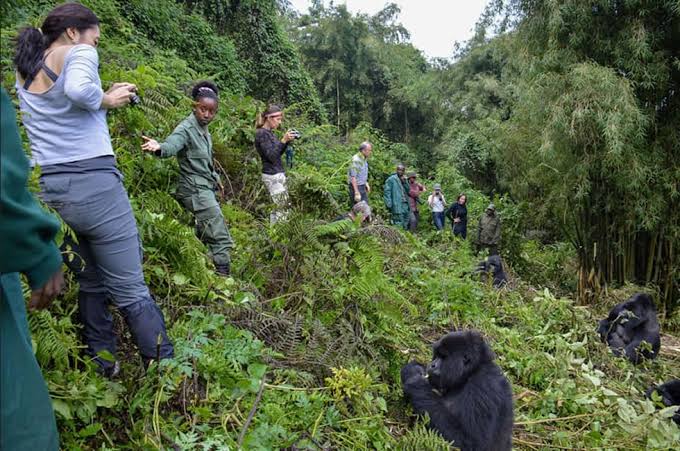
- Walking regularly before the trip.
- Training on hills or stairs.
- Wearing broken-in hiking boots.
- Hiring a porter.
- Carrying only essential items.
- Drinking enough water.
- Using a walking stick.
- Informing the ranger about mobility concerns.
- Moving at a steady pace.
During the briefing, visitors can ask to be considered for a more manageable trekking group. However, gorillas are wild animals, so an easy route cannot be guaranteed.
Gorilla Trekking Rules Every Visitor Should Know
Responsible behavior protects the gorillas and visitors.
Common trekking rules include:
- Follow your ranger’s instructions.
- Do not trek when seriously ill or showing symptoms of an infectious condition.
- Keep the required distance from the gorillas.
- Do not touch the gorillas.
- Avoid sudden movements.
- Speak quietly.
- Do not eat or drink near the gorillas.
- Do not use flash photography.
- Stay with your assigned group.
- Do not leave rubbish in the forest.
- Cover your mouth and turn away if you need to cough or sneeze.
- Respect the one-hour viewing limit.
- Never block a gorilla’s path.
- Remain calm if a gorilla approaches.
Gorillas sometimes move closer than the normal viewing distance. If that happens, stay still and follow the ranger’s directions.
Best Time to Book a Uganda Gorilla Trek
Mountain gorilla trekking is available throughout the year. Each season offers different advantages.
June to September
These months are popular because conditions are often relatively dry.
Advantages include:
- Less rainfall on average.
- Firmer trails.
- Easier combination with classic wildlife safaris.
- Convenient Northern Hemisphere holiday dates.
Challenges include:
- High permit demand.
- Higher lodge occupancy.
- Less flexibility for last-minute bookings.
- Peak-season accommodation prices.
December to February
This is another popular period with generally favorable travel conditions.
Advantages include:
- Good road conditions in many areas.
- Attractive weather for multi-park safaris.
- Convenient festive-season travel.
- Good conditions for photography.
Challenges include:
- Strong demand around Christmas and New Year.
- Higher holiday-season prices.
- Limited availability at small lodges.
April, May and November
These are the official promotional months associated with discounted permits for qualifying foreign visitors.
Advantages include:
- USD 600 foreign non-resident permits.
- USD 500 foreign-resident permits.
- Fewer visitors.
- Lush green forest.
- Potential lodge discounts.
- More permit flexibility before purchase.
Challenges include:
- More rain.
- Muddy trails.
- Slippery slopes.
- Stricter conditions on discounted permits.
- Longer road journeys in poor weather.
Rain does not mean it rains continuously every day. Tropical weather can change quickly. Nevertheless, visitors should prepare for wet conditions in any month.
Budget gorilla safari
A budget package normally includes:
- A standard permit.
- Shared or economical private transport.
- Budget lodge accommodation.
- Meals stated in the itinerary.
- Drinking water during transfers.
- Driver-guide services.
Midrange gorilla safari
A midrange package usually provides:
- A comfortable lodge.
- En-suite accommodation.
- Full-board meals near Bwindi.
- Private or small-group transport.
- An experienced English-speaking driver-guide.
- Better itinerary flexibility.
Luxury gorilla safari
A luxury package may include:
- Premium forest accommodation.
- Domestic flights.
- Private transfers.
- Fine dining.
- Personalized service.
- Spa treatments.
- Private cultural experiences.
- High-end safari vehicles.
- Dedicated concierge support.
The gorilla permit price remains fixed for the visitor category. Luxury affects the surrounding services rather than the official standard permit.
Sample Three-Day Uganda Gorilla Safari Budget
A three-day journey from Kigali or Entebbe is one of the most popular formats.
Day 1: Transfer to Bwindi
The traveler is collected from the airport or hotel and driven to the correct Bwindi sector. The journey includes scenic stops, border formalities when arriving from Rwanda and lunch en route.
Day 2: Gorilla trekking
After an early breakfast, the traveler reports to park headquarters for briefing and gorilla trekking. The afternoon is kept flexible for rest or a community activity.
Day 3: Return transfer
After breakfast, the traveler returns to Kigali, Entebbe or the next safari destination.
Gorilla Trekking from Kigali vs Entebbe
Uganda’s gorilla parks can be reached from either Uganda or Rwanda.
Starting from Kigali
Kigali is relatively close to southern Bwindi and Mgahinga. The route passes through Rwanda before crossing into Uganda.
Advantages include:
- Shorter driving time to southern sectors.
- Convenient combination with Rwanda.
- Suitable for short gorilla safaris.
- Access to Rushaga, Nkuringo and Mgahinga.
- Opportunity to visit Kigali before or after trekking.
Travelers must meet the immigration and visa requirements for both Rwanda and Uganda.
Starting from Entebbe or Kampala
The overland journey from Entebbe or Kampala is much longer. However, it creates an opportunity to explore more of Uganda.
The route can include:
- Lake Mburo National Park.
- Queen Elizabeth National Park.
- Ishasha’s tree-climbing lion region.
- Kibale National Park.
- Equator stops.
- Community and cultural experiences.
Travelers with limited time can take a scheduled domestic flight to an airstrip near Bwindi and continue by road to the lodge.
Uganda vs Rwanda Gorilla Permit Prices
Uganda and Rwanda both offer regulated mountain gorilla trekking, but their permit prices and logistics differ.
| Feature | Uganda | Rwanda |
|---|---|---|
| Standard foreign visitor permit | USD 800 | USD 1,500 |
| Discounted Uganda low-season rate | USD 600 | Not generally equivalent |
| Gorilla parks | Bwindi and Mgahinga | Volcanoes National Park |
| Main gateway | Entebbe or Kigali | Kigali |
| Driving convenience | Longer from Entebbe; shorter from Kigali to southern Uganda | About 2.5–3 hours from Kigali |
| Habituation experience | Available in Uganda | Not offered in the same standard format |
| Trekking sectors | Several | Centralized around Volcanoes |
| Best for | Value and longer Uganda safaris | Short, convenient or luxury-focused trips |
Uganda can save a foreign visitor USD 700 on the standard permit compared with Rwanda. A couple can save USD 1,400 on permits alone.
During Uganda’s qualifying low season, the difference can reach USD 900 per person.
However, price should not be the only consideration. Rwanda has an important logistical advantage because Volcanoes National Park is easy to reach from Kigali. This makes a short two-day itinerary practical.
Uganda offers greater variety, more trekking sectors and the Gorilla Habituation Experience. It also combines naturally with chimpanzee trekking, Big Five safaris and boat cruises.
How to Save Money on a Uganda Gorilla Safari
Travel during the official low season
April, May and November provide the strongest direct permit savings for eligible foreign visitors.
Join a small group
Transport is a major safari expense. Sharing a vehicle can reduce the per-person cost without reducing the quality of the gorilla encounter.
Start in Kigali for a short trip
If your goal is only to visit southern Bwindi or Mgahinga, starting in Kigali can reduce overland travel time.
Use comfortable budget or midrange lodges
Uganda offers good-value lodges near most trekking sectors. A clean, well-located lodge can be more practical than an expensive property far from headquarters.
Book the correct sector
Avoid unnecessary transfers by matching the lodge to the permit sector.
Combine destinations efficiently
A logical route reduces repeated driving. For example:
- Kigali–Mgahinga–Lake Mutanda–Kigali
- Kigali–Rushaga–Nkuringo–Kigali
- Entebbe–Lake Mburo–Bwindi–Queen Elizabeth
- Entebbe–Kibale–Queen Elizabeth–Bwindi
- Kigali–Bwindi–Ishasha–Queen Elizabeth–Entebbe
Compare complete quotations
The cheapest advertised package is not always the best value. Check whether the quotation includes permits, meals, fuel, park fees and border transfers.
Common Uganda Gorilla Permit Booking Mistakes
Waiting too long
Peak-season dates can sell out. Start with permits before making non-refundable lodge reservations.
Booking accommodation first
The available permit may be in a different sector from the chosen lodge.
Confusing a permit with a package
The USD 800 fee does not include transport and accommodation.
Using the wrong resident category
A short stay does not make someone a foreign resident. Proper documentation is required.
Ignoring transfer time
Bwindi’s sectors are not all close to each other.
Choosing a low-season permit before confirming flights
Discounted permits generally cannot be rescheduled.
Entering incorrect passport details
Names and identification information must match the traveler’s documents.
Planning a flight immediately after trekking
The trek duration is unpredictable. Keep enough time between the forest experience and the next transport connection.
Paying an unverified seller
Use UWA or a legitimate tour operator. Request invoices, company information and written confirmation.
Packing List for a Uganda Gorilla Trek
A thoughtful packing list makes the trek safer and more comfortable.
Essential clothing
- Lightweight long trousers.
- A long-sleeved shirt.
- Waterproof hiking boots.
- Moisture-wicking socks.
- A rain jacket or poncho.
- Gardening gloves.
- A warm layer for cool mornings.
- A sun hat.
Useful equipment
- A small backpack.
- Reusable water bottle.
- Camera with spare batteries.
- Waterproof camera protection.
- Binoculars.
- Insect repellent.
- Sunscreen.
- Personal medication.
- Gaiters.
- Walking stick.
Avoid carrying unnecessary weight. A porter can carry your daypack and assist on difficult sections.
Photography Tips During Gorilla Trekking
Gorilla photography can be challenging because the forest is dark and the animals may move between leaves and branches.
For better results:
- Turn off the flash before entering the forest.
- Use a camera that performs well in low light.
- Select a moderately fast shutter speed.
- Increase ISO when necessary.
- Keep equipment protected from rain.
- Carry spare batteries.
- Avoid changing lenses in wet or dusty conditions.
- Listen to your guide before moving position.
- Take some photographs, but also spend time observing without the camera.
Do not bring excessive equipment unless you can carry it comfortably or have arranged a porter.
Why Uganda Gorilla Permits Support Conservation
The price of a gorilla permit can appear high when viewed only as an entrance charge. In reality, controlled gorilla tourism supports a much wider conservation system.
Permit revenue contributes to:
- Daily ranger patrols.
- Anti-poaching programs.
- Veterinary care.
- Research and monitoring.
- Habitat protection.
- Visitor management.
- Community development.
- Employment around the parks.
- Conservation education.
Limiting daily visitor numbers also reduces pressure on gorilla families. This controlled approach helps balance tourism with animal welfare and habitat protection.
Local tourism employment can include:
- Rangers.
- Trackers.
- Porters.
- Driver-guides.
- Lodge staff.
- Craftspeople.
- Farmers.
- Cultural performers.
- Community guides.
Therefore, a well-managed gorilla safari can generate benefits beyond the visitor’s one-hour encounter.
Frequently Asked Questions About Uganda Gorilla Permits
How much is a Uganda gorilla permit?
A standard Uganda gorilla trekking permit costs USD 800 for a foreign non-resident, USD 700 for a foreign resident, USD 500 for qualifying other African citizens and UGX 300,000 for East African citizens. Promotional conditions may apply in selected months.
How much is a low-season Uganda gorilla permit?
Foreign non-residents can pay USD 600, while foreign residents can pay USD 500 for qualifying treks during April, May and November. Confirm the conditions before booking because discounted permits are generally non-reschedulable.
What is included in the USD 800 permit?
It includes the guided gorilla trek, park entrance for the trekking day, ranger and tracker services, up to one hour with a habituated family and a community development contribution.
Does the permit include accommodation?
No. Accommodation must be booked separately or included within a safari package.
Does the permit include transportation?
No. You need transport to the assigned park headquarters.
How long can I stay with the gorillas?
A standard permit allows up to one hour after the gorillas are located.
How much does gorilla habituation cost?
The 2026 foreign non-resident price has been USD 1,500. Revised UWA information lists USD 1,800 for foreign non-residents under the updated schedule. Confirm the applicable rate for your exact travel date.
How long is the Gorilla Habituation Experience?
Participants may spend up to four hours with a gorilla family undergoing habituation, after the encounter begins.
Where does gorilla habituation take place?
It is generally offered in the Rushaga area of southern Bwindi, subject to UWA operations and availability.
Can children trek gorillas in Uganda?
The normal minimum age is 15 years.
Can I book a permit at the park gate?
Do not depend on purchasing a permit on arrival. Availability is limited, and advance booking is strongly recommended.
Can I book a Uganda permit from Rwanda?
Yes. A tour operator can arrange a Uganda permit and a cross-border itinerary beginning in Kigali. You must meet the entry requirements for both countries.
Are Uganda gorilla permits cheaper than Rwanda permits?
Yes. Uganda’s standard foreign non-resident permit is USD 800, while Rwanda’s standard international permit is USD 1,500.
Is Bwindi or Mgahinga better?
Both offer excellent trekking. Bwindi has more gorilla families, sectors and accommodation choices. Mgahinga offers a smaller-scale experience and combines well with golden monkeys and Virunga hiking.
Is gorilla trekking guaranteed after buying a permit?
The permit guarantees your place on the trek, not a completely predictable encounter. Mountain gorillas are wild animals. However, trackers monitor habituated families daily, and successful encounters are very common.
What happens if I am sick?
Report symptoms honestly. Gorillas are vulnerable to human illnesses. UWA staff will determine whether you can trek and whether any applicable refund policy applies.
Can I trek twice?
Yes. You must buy a separate permit for each trekking date. Two treks may produce very different experiences because each family and forest route is unique.
Are porters included?
No. Porters are hired separately. Their assistance is highly recommended.
Can senior travelers trek?
Yes, provided they are medically fit for the activity. Travelers should explain their mobility needs in advance and consider hiring porters or arranging additional assistance.
Final Uganda Gorilla Permit Price Guide Booking Checklist
Before traveling, confirm that you have:
- A valid gorilla permit.
- The correct trekking date.
- The correct park and sector.
- A passport matching the booking.
- Accommodation near the correct headquarters.
- Reliable transport.
- Appropriate hiking clothes.
- Waterproof boots.
- A rain jacket.
- Gloves and gaiters.
- Drinking water.
- A packed lunch.
- Travel insurance.
- Funds for a porter and tips.
- Enough time after the trek.
- Written emergency contact details.
Conclusion
A Uganda gorilla permit is the foundation of every successful gorilla trekking safari. For most foreign non-residents, the standard price is USD 800 per person. During April, May and November, qualifying travelers may secure the official USD 600 low-season rate. Foreign residents pay USD 700 under the standard tariff or USD 500 during qualifying promotional months.
Uganda’s combination of competitive permit prices, several trekking sectors and two gorilla national parks makes it one of the world’s leading primate destinations. In addition, the Gorilla Habituation Experience offers a longer and more specialized encounter for travelers seeking deeper observation.
The most important lesson from this Uganda Gorilla Permit Price Guide is to secure the permit before finalizing the rest of the safari. Confirm the trekking date, sector, visitor category and conditions in writing. Then reserve accommodation near the assigned headquarters and organize suitable transport.
Whether you choose Buhoma, Ruhija, Rushaga, Nkuringo or Mgahinga, early planning will protect your budget and improve the entire experience. With the right preparation, gorilla trekking in Uganda becomes more than a wildlife activity. It becomes a carefully managed journey that supports mountain gorilla conservation, local employment and the long-term protection of Uganda’s remarkable forests.
Book Your Uganda Gorilla Permit with Universal Ventures Rwanda
Planning a gorilla trekking safari in Uganda requires more than purchasing a permit. You must select the right trekking date, confirm the correct Bwindi sector, reserve nearby accommodation and organize reliable transportation.
Universal Ventures Rwanda can help you check Uganda gorilla permit availability and arrange a complete Uganda gorilla safari. The team can also organize cross-border gorilla trekking tours starting from Kigali, Rwanda, with transfers to Bwindi Impenetrable National Park or Mgahinga Gorilla National Park.
Contact Universal Ventures Rwanda
Phone/WhatsApp: +250 781 441 853
Email: info@universalventuresrwanda.com
Address: KN 15 Road, opposite IPRC Entrance, 1st Floor, Sangwa Plaza, Kigali, Rwanda
Website: www.universalventuresrwanda.com