
A Kenya safari road trip is one of the most rewarding ways to experience East Africa. Instead of flying directly from one safari lodge to another, traveling overland allows you to watch Kenya change gradually around you. Nairobi’s busy streets give way to the escarpments of the Great Rift Valley, agricultural highlands become acacia-covered plains, and eventually elephants, giraffes, zebras and antelope begin appearing beyond the road.
For many travelers, the road itself becomes part of the safari.
Kenya is particularly suitable for an overland wildlife journey because its famous safari destinations can be connected into several logical circuits. You can drive from Nairobi toward Amboseli National Park beneath Mount Kilimanjaro, continue through the immense wilderness of Tsavo and finish beside the Indian Ocean. Another route heads through the Great Rift Valley toward Lake Naivasha, Lake Nakuru and the legendary Masai Mara. Travelers with more time can turn north toward Mount Kenya, Ol Pejeta, Laikipia and Samburu.
The challenge is not finding places worth visiting. It is deciding how many destinations can realistically fit into one itinerary.
A poorly designed Kenya safari itinerary can involve long transfers almost every day. A well-designed road trip gives you enough time to enjoy game drives, scenery, lodges and quiet afternoons rather than simply collecting national parks.
This Kenya Safari Road Trip Guide explains how to build that kind of journey. It covers the country’s main road safari circuits, realistic transfer times, wildlife highlights, vehicle choices, seasons, accommodation, park regulations, travel documents and practical planning advice.
Whether you want a private guided safari, a Kenya self-drive adventure, a family safari or a longer East African journey, thoughtful route planning will make the difference between a tiring trip and an exceptional one.
Why a Kenya Safari Road Trip Is Worth Doing
Kenya is frequently imagined through individual destinations: lions in the Masai Mara, elephants in Amboseli, flamingos around Rift Valley lakes or red-soil landscapes in Tsavo. Yet seeing these environments as part of one continuous journey gives travelers a much stronger sense of the country.
Driving south from Nairobi toward Amboseli, for example, introduces progressively drier landscapes and increasingly expansive views. Around the park, seasonal wetlands attract elephants and other wildlife while Kilimanjaro dominates the southern horizon when visibility is favorable.
Heading west instead creates an entirely different journey. The road descends through the Great Rift Valley toward Naivasha and Nakuru before eventually reaching the grasslands associated with the greater Mara ecosystem.
Northern Kenya changes again. Nanyuki and Mount Kenya lead toward Laikipia before increasingly arid landscapes announce the approach to Samburu.
A road safari therefore offers something flights cannot: geographical continuity.
Travelers also gain flexibility. A private vehicle can stop at viewpoints, roadside landscapes or designated places along the journey. Departure times can often be adapted around the day’s plans, while the same vehicle can frequently remain with the travelers throughout much of their safari.
There is also practical value. For couples, families and small private groups, road travel can sometimes provide better overall value than combining multiple charter flights, particularly where parks are connected efficiently.
The important word is efficiently.
Trying to drive between too many distant destinations simply because they appear on a Kenya safari map can work against the experience. A road trip should create a natural flow rather than become a race around the country.
Kenya Safari Road Trip Guide to Choosing the Right Route
The best route depends on the number of days available, wildlife priorities, season, preferred accommodation and whether the journey should finish back in Nairobi or continue toward Kenya’s coast.
First-time visitors commonly want to see Masai Mara and Amboseli. Both are excellent destinations, but they lie in different directions from Nairobi. Combining them entirely by road therefore requires more transfer time than visiting destinations that naturally fall along the same geographical corridor.
For travelers primarily interested in the Great Migration, big cats and classic open plains, the Masai Mara should normally receive several nights rather than being squeezed into a short stay.
Those drawn toward elephant herds, Kilimanjaro landscapes and southeastern Kenya may prefer an Amboseli–Tsavo route.
Travelers interested in variety can combine Rift Valley lakes with the Masai Mara.
Those who prefer fewer safari vehicles, more wilderness and northern Kenyan landscapes may find Ol Pejeta, Laikipia and Samburu especially rewarding.
Good itinerary planning begins with your main objective and builds outward from it.
Do not begin by asking, “How many parks can we visit?”
Ask, “Which experiences matter most?”
That single change usually produces a better safari.
Nairobi: The Natural Starting Point for a Kenya Safari Road Trip
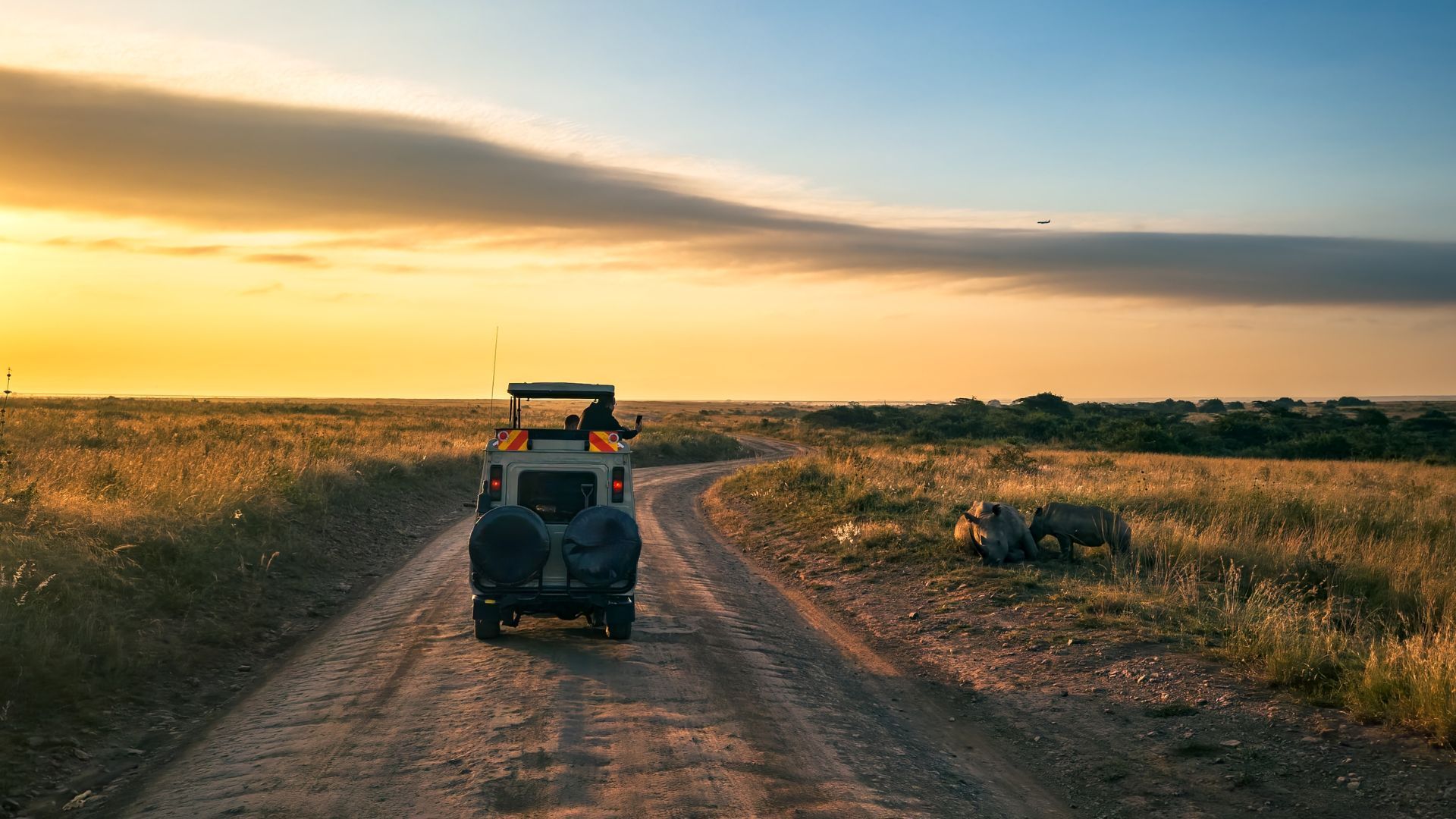
Most international road safaris begin in Nairobi because Jomo Kenyatta International Airport is Kenya’s major international gateway and the city sits conveniently between several safari circuits.
It is tempting to land, collect luggage and immediately drive several hours into the countryside. That can work after a short regional flight, but visitors arriving after overnight international travel generally benefit from spending at least one night in Nairobi.
That first night provides recovery time and creates a buffer against delayed luggage or international flight disruption.
Nairobi itself can also be part of the wildlife experience. Nairobi National Park sits remarkably close to the capital and offers game viewing against an unusual urban skyline.
It is particularly useful for travelers with a spare morning or afternoon before continuing to another safari area.
Kenya Wildlife Service currently states that park gates generally operate from 6:00 AM to 6:00 PM for day visitors and requires visitors to remain on established roads, observe park speed restrictions and stay inside vehicles except at designated places.
Leaving Nairobi early is often advantageous on long transfer days. Traffic around the city and major highways can significantly influence actual driving times, so safari schedules should never be based solely on the number of kilometers shown on a navigation application.
Nairobi to Masai Mara Road Trip
The Nairobi to Masai Mara journey is arguably Kenya’s most famous safari road transfer.
Depending on the gate, traffic and exact route, travelers should generally think in terms of roughly five to seven hours rather than treating it as a short transfer. Current route guides place the journey at approximately 225–275 kilometers depending on the destination within the Mara ecosystem.
The drive normally leads away from Nairobi toward the Great Rift Valley before continuing through Narok and onward toward the reserve or surrounding conservancies.
This journey illustrates why distance alone is misleading in Kenya.
Two hundred and seventy kilometers on an uninterrupted motorway would be relatively easy. Safari travel involves urban traffic, trucks, towns, fuel stops, changing road surfaces and eventually slower movement on roads near wildlife areas.
Allowing the better part of a day means travelers can stop comfortably rather than becoming anxious about reaching camp before an afternoon activity.
The transformation in scenery is one of the reasons road travel is worthwhile. The densely developed capital gradually disappears, the Rift Valley opens below the escarpment, agricultural landscapes appear around Narok and eventually the open grasslands associated with the Mara begin dominating the horizon.
Making the Masai Mara Part of a Kenya Safari Road Trip
A common mistake is spending only one night in the Masai Mara after making the long drive there.
Two nights gives one full safari day.
Three nights is considerably better for travelers whose primary objective is wildlife.
Four nights can be justified during migration season, for photography-focused trips or when splitting accommodation between different areas of the ecosystem.
The Mara rewards patience. Lions that appear inactive at noon may become extremely active later in the day. A cheetah may spend an hour watching the plains before suddenly beginning a hunt. Elephant herds can disappear behind distant hills and return hours later.
More time means less pressure to chase every radio report and greater opportunity to simply watch wildlife behave naturally.
Masai Mara Wildlife Experience
The Masai Mara is synonymous with African safari for good reason.
Its open grasslands support significant populations of herbivores as well as lions, leopards, cheetahs and hyenas. Elephants, giraffes, buffalo, zebra, topi, wildebeest and numerous antelope species occupy different parts of the ecosystem.
From roughly July into October, depending on rainfall and ecological conditions, large numbers of wildebeest and zebra associated with the wider Serengeti–Mara migration system may enter the Kenyan side.
The exact timing should never be treated as guaranteed.
Nature does not follow a tourism calendar.
Travelers whose entire trip depends upon witnessing a river crossing should therefore understand that even during the general migration period there can be long periods with no crossing activity at a particular location.
A good safari should value the entire ecosystem rather than only one dramatic event.
Outside peak migration months, the Mara remains one of Africa’s premier wildlife destinations and can offer a quieter safari experience.
Nairobi to Amboseli: The Kilimanjaro Safari Route
Amboseli is another excellent destination for an overland safari from Nairobi.
Current safari route estimates generally place the road journey at approximately four to five hours depending on traffic, route, weather and the specific park entrance being used. Kenya Wildlife Service recognizes different road approaches and also notes the connection onward toward Tsavo West through the Kimana side of the park.
Amboseli is famous for elephants and views toward Mount Kilimanjaro.
The combination creates some of East Africa’s most recognizable safari photography: elephant families walking across dusty plains beneath Africa’s highest mountain.
Kilimanjaro is actually across the international border in Tanzania, but the mountain dominates the skyline from sections of Amboseli.
Clear views are never guaranteed. Cloud frequently develops around the summit, meaning early mornings often offer particularly good opportunities.
The wetlands of Amboseli form another important part of the ecosystem. Water associated with Kilimanjaro’s underground drainage supports marshy habitats that contrast dramatically with the surrounding dry plains.
This diversity attracts elephants, buffalo, hippos, antelope and abundant birdlife.
Two nights in Amboseli works for many itineraries, while three nights provides a much more relaxed experience.
Amboseli to Tsavo: One of Kenya’s Best Safari Road Connections
One of the smartest ways to design a Kenya safari road trip is to connect Amboseli with Tsavo rather than automatically returning to Nairobi.
Kenya Wildlife Service confirms a road link between Amboseli and Tsavo West through the Kimana area.
This creates an appealing safari circuit because the landscapes change significantly despite the relative geographical connection.
Amboseli feels open and expansive.
Tsavo West becomes more rugged, volcanic and vegetated.
Tsavo East opens again into enormous red-earth wilderness.
Together, the parks create one of Kenya’s most interesting overland journeys.
Travelers continuing toward Mombasa or Diani Beach can then use Tsavo as the natural bridge between inland safari country and the Indian Ocean.
Exploring Tsavo West National Park
Tsavo West is dramatically different from the stereotypical endless-grass safari image.
Its landscape incorporates volcanic formations, hills, lava fields, springs and thicker vegetation.
The denser habitat can occasionally make wildlife harder to spot than on wide-open plains, but this is precisely what makes the park interesting. Each sighting feels earned, and the landscape itself becomes part of the attraction.
Tsavo West also carries considerable historical significance connected with the construction of the Kenya–Uganda railway and the famous lions associated with the Tsavo region. Kenya Wildlife Service highlights both the area’s wildlife and its wider cultural and historical significance.
When paired with Amboseli and Tsavo East, Tsavo West adds important ecological variety to the route.
Tsavo East and Kenya’s Red-Earth Wilderness
Tsavo East is immense.
Kenya Wildlife Service describes the park as covering approximately 13,747 square kilometers and forming part of the much larger Tsavo Conservation Area together with Tsavo West.
Its scale produces a very different feeling from smaller parks.
Long roads stretch through red earth and semi-arid wilderness. Elephants coated in Tsavo’s distinctive red dust create some of the park’s most memorable scenes.
The size also means route planning matters. Travelers should not assume they can enter one side, explore every major wildlife area and exit another gate quickly.
Choosing accommodation according to the direction of travel is particularly useful here.
For guests traveling from Nairobi toward the coast, positioning lodge nights near the correct sections of Tsavo can significantly reduce unnecessary backtracking.
KWS lists several road access points along the Nairobi–Mombasa corridor, including Voi, Bachuma, Manyani and Mtito Andei connections.
That highway access is one reason Tsavo fits so naturally into a Kenya safari and beach holiday.
Nairobi to Lake Naivasha Road Trip
Lake Naivasha provides one of the easiest ways to break a western safari route into more comfortable stages.
Rather than heading directly toward the Masai Mara, travelers can spend a night or two around Naivasha and enjoy an entirely different style of experience.
Boat excursions offer opportunities to see hippos and waterbirds. Nearby attractions may include Crescent Island and Hell’s Gate National Park depending on individual interests.
Naivasha also works as a relaxing midpoint.
After several early safari mornings, sitting beside a lake for part of an afternoon can be surprisingly valuable.
The area is therefore not merely a place to add another activity. It can improve the rhythm of the entire itinerary.
Lake Nakuru National Park
Lake Nakuru National Park is compact compared with destinations such as Tsavo or the Mara, making it relatively easy to explore.
The park combines lake scenery, woodland, grassland and escarpment habitats.
It has long been associated with flamingos, although bird numbers around Rift Valley lakes naturally fluctuate according to water levels, food availability and broader ecological conditions.
Rhino conservation is another major reason travelers include Nakuru in their itineraries.
A road itinerary can combine Naivasha and Nakuru efficiently before continuing toward the Mara.
This creates a natural progression from Nairobi through the Rift Valley toward southwestern Kenya rather than treating every park as an isolated destination.
Nairobi, Naivasha, Nakuru and Masai Mara Safari Route
For travelers wanting an entirely road-based trip, the Nairobi–Naivasha–Nakuru–Masai Mara circuit remains one of the strongest options.
It balances relatively short early transfers with a longer drive into the Mara.
A good itinerary might begin with Nairobi, continue for one or two nights around Naivasha, include Nakuru and finish with several nights in the Masai Mara.
The advantage is variety.
Naivasha introduces lake activities.
Nakuru adds a compact national park environment.
The Mara delivers expansive savannah and predator-rich game viewing.
The route also avoids the temptation to cross the entire country repeatedly.
That principle is worth emphasizing throughout this Kenya Safari Road Trip Guide: good routing matters more than the number of destinations.
Northern Kenya Road Trip: Mount Kenya, Ol Pejeta and Samburu
Travelers who want something different from the classic southern circuit should consider heading north from Nairobi.
Mount Kenya country introduces fertile highlands and dramatic mountain scenery before the environment gradually becomes drier toward Samburu.
Ol Pejeta Conservancy is a popular inclusion around the Laikipia region and offers wildlife experiences that complement the traditional national park circuit.
From there, travelers can continue north toward Samburu, Buffalo Springs and surrounding conservation areas.
A current central Kenya itinerary published by Africa Off Track estimates Nairobi to Ol Pejeta at around four to five hours and Ol Pejeta onward toward Samburu at around three to four hours, although actual times naturally depend on route and conditions.
The northern circuit appeals especially to repeat visitors and wildlife enthusiasts because the ecosystem differs from southern Kenya.
Samburu is associated with species adapted to the arid north, including Grevy’s zebra, reticulated giraffe, gerenuk and Beisa oryx.
The Ewaso Nyiro River forms a vital wildlife corridor through an otherwise dry landscape.
Combining Samburu with Laikipia or Ol Pejeta creates a safari that feels markedly different from the Mara.
How Long Should a Kenya Safari Road Trip Be?
There is no universal perfect length, but duration strongly affects quality.
A four- or five-day road safari should normally focus on one main region.
Attempting Nairobi, Amboseli, Nakuru and Masai Mara in five days may be physically possible under certain schedules, but much of the trip will be spent transferring between destinations.
Seven days creates far more flexibility.
Nine to ten days allows two or three major ecosystems to be explored properly.
Twelve to fourteen days opens possibilities for more ambitious circuits without requiring constant movement.
Current Kenya itinerary specialists increasingly emphasize realistic pacing rather than attempting to include four or five parks within a short holiday. SafariKenya, for example, argues for spending more time in fewer ecosystems, while other road-focused itinerary guides similarly emphasize the relationship between driving hours and actual wildlife time.
That is sound advice.
Travelers do not remember a safari according to how many pins appeared on their map.
They remember the lion pride they watched wake after sunrise, the elephant calf playing beside its mother, the dinner beneath an enormous African sky and the morning Kilimanjaro appeared without clouds.
Allow time for those moments.
Five-Day Kenya Safari Road Trip
With five days, concentration is important.
One option is Nairobi to Amboseli for two nights before continuing through another southeastern destination or returning to Nairobi.
Another possibility is Nairobi to Naivasha followed by several nights in the Masai Mara.
Travelers with wildlife as their absolute priority could simply spend the majority of the trip in the Mara rather than trying to add additional parks.
This approach often creates better value because park fees, transfers and repeated check-ins all consume both money and time.
Seven-Day Kenya Safari Road Trip
Seven days is enough to build a satisfying classic road circuit.
A Rift Valley itinerary might combine Nairobi, Naivasha or Nakuru and the Masai Mara.
A southern itinerary could combine Nairobi, Amboseli, Tsavo West and Tsavo East.
Travelers finishing on the coast can continue from Tsavo toward Mombasa or Diani instead of returning to Nairobi.
That creates particularly efficient geography.
The safari gradually moves from inland Kenya toward the Indian Ocean, so nearly every major transfer advances the journey rather than retracing it.
Ten-Day Kenya Safari Road Trip
Ten days allows travelers to begin slowing down.
A classic itinerary can dedicate several nights to each major wildlife area while retaining time for Naivasha, cultural experiences or a relaxing afternoon.
For example, the western route could include Nairobi, Ol Pejeta, Naivasha and Masai Mara.
Alternatively, travelers wanting Kilimanjaro scenery and the coast could travel Nairobi, Amboseli, Tsavo West, Tsavo East and then continue to Diani.
A third option would focus on northern Kenya through Ol Pejeta and Samburu before finishing with the Masai Mara using either road or a strategic domestic flight.
Hybrid journeys can sometimes solve difficult geography.
Not every transfer has to be driven simply because the overall holiday is described as a road trip.
Fourteen-Day Grand Kenya Safari
Two weeks opens much greater possibilities.
Travelers can combine northern and southern ecosystems, spend several nights in key parks and still include downtime.
A broad itinerary might begin in Nairobi, travel toward Ol Pejeta and Samburu, return through the Rift Valley, continue to Naivasha or Nakuru and end in the Masai Mara.
Alternatively, the entire journey can run south and east through Amboseli and Tsavo before reaching the Indian Ocean.
Trying to include Samburu, Masai Mara, Amboseli, both Tsavos and the coast entirely by road in only two weeks requires careful consideration.
It can be done in some arrangements, but the resulting driving load may not be right for everyone.
A carefully chosen internal flight can sometimes transform such an itinerary from exhausting to comfortable.
Realistic Driving Times Matter More Than Kilometers
This is one of the most important lessons when planning a Kenya safari road trip.
Do not design your itinerary using European or North American assumptions about road distance.
Kenya has excellent paved highways in many areas, but a safari itinerary also involves urban congestion, slow trucks, road construction, towns, speed controls, livestock, weather and unpaved sections.
Inside wildlife areas, the objective is not speed at all.
Roadtrip Africa recommends using much lower average speeds when estimating Kenyan travel days, especially once inside national parks, where safari tracks are deliberately slow.
That means a 250-kilometer journey could occupy much of the day.
Likewise, “three hours on Google Maps” should not automatically become a three-hour safari transfer.
A knowledgeable operator plans around realistic road conditions rather than theoretical travel time.
Choosing the Right Vehicle for a Kenya Safari Road Trip
Your vehicle is one of the most important parts of an overland safari.
You may spend dozens of hours inside it during a longer journey.
Comfort, reliability and visibility therefore matter.
The most common private safari vehicle is a modified 4×4 Toyota Land Cruiser with a pop-up roof.
These vehicles are popular for good reason. High clearance helps on rough roads, four-wheel drive provides additional capability in difficult conditions, and the raised roof allows passengers to stand safely for wildlife viewing while the vehicle is stationary.
Some Kenya safari operators also use customized safari vans.
They can work well on many established routes, particularly during dry conditions, and may offer a more economical option.
However, travelers planning substantial off-road-style park tracks, remote routes or rainy-season safaris generally gain reassurance from a strong 4×4.
Why a 4×4 Matters on a Kenya Safari
A road that is easy in February can look completely different after heavy rain.
Black-cotton soil in certain wildlife areas can become extremely slippery.
Deep ruts, muddy sections, rocky tracks and seasonal washouts may transform a seemingly straightforward journey.
Four-wheel drive does not make a vehicle unstoppable, but it greatly increases capability.
Tyre condition is equally important.
So are a working spare tyre, jack, wheel tools and basic recovery equipment.
For longer self-drive trips, a second spare can be valuable depending on the route.
Vehicle selection should therefore consider where you are going rather than simply choosing the cheapest rental car available in Nairobi.
Guided Safari or Kenya Self-Drive Safari?
Both can produce excellent trips, but they provide very different experiences.
A private guided safari removes much of the logistical burden.
Your driver-guide handles navigation, road conditions, park gates and many practical details. Experienced safari guides also understand animal behavior and often communicate with other guides regarding wildlife movements.
That knowledge can make an enormous difference.
A leopard lying under a bush might be almost invisible to an inexperienced traveler. A guide who knows the animal’s territory may notice signs immediately.
Guided travel also allows every traveler in the vehicle to concentrate on scenery rather than traffic.
Self-drive travel offers independence.
Travelers can choose their own departure times, determine where to stop and create a more personal sense of exploration.
However, freedom comes with additional responsibility.
Navigation, vehicle condition, breakdowns, fuel planning, park rules and wildlife awareness become your responsibility.
KenyaAssist notes that many KWS parks accommodate self-drive visitors, although local rules and access arrangements should always be checked for the individual destination.
For experienced African road travelers, self-drive can be extremely rewarding.
For a first safari, particularly where wildlife is the main objective, a professional driver-guide is often worth the additional cost.
Kenya Self-Drive Safari Planning
Anyone planning self-drive Kenya should begin with the route rather than the vehicle.
Identify the furthest destination, investigate actual road conditions and determine where fuel, accommodation and assistance are available.
Avoid unnecessary night driving.
Even when a highway is paved, darkness introduces additional hazards including pedestrians, livestock, poorly lit vehicles and reduced visibility.
Wildlife areas introduce another layer of complexity.
GPS navigation is useful, but navigation apps should not replace local knowledge.
A road shown on a digital map may be seasonal, damaged or unsuitable for the vehicle being used.
Ask lodge staff and park rangers about current conditions before taking unfamiliar secondary routes.
A reliable local SIM card, offline maps and emergency contact numbers can also make travel easier.
Park Rules Every Safari Traveler Should Respect
Wildlife parks are not theme parks.
The animals are wild, and visitors enter their habitat.
Kenya Wildlife Service’s current visitor guidance emphasizes giving animals right of way, remaining inside vehicles except in designated areas, keeping to established tracks and avoiding behavior that disturbs wildlife. KWS also lists a maximum park speed of 40 km/h in its visitor guidance for Nairobi National Park and advises maintaining distance from wildlife.
Those rules exist for both safety and conservation.
Driving off designated tracks damages vegetation and can disturb breeding or resting animals.
Blocking elephants because you want a better photograph can cause unnecessary stress.
Crowding a cheetah hunt with vehicles changes the animal’s environment.
Responsible safari travel means accepting that wildlife controls the experience.
Sometimes the best decision is to turn off the engine and wait.
Kenya Park Fees and Entry Payments
Park charges should always be checked during the booking process because fees and payment systems can change.
Kenya Wildlife Service introduced revised conservation fees under the 2025 regulations, which took effect from October 1, 2025.
For self-organized travelers, KWS currently directs visitors toward its KWS Pay/eCitizen system and lists electronic payment methods including M-Pesa, Visa and bank transfer. Travelers on organized safari packages will commonly have applicable park entrance fees incorporated into their tour cost.
Always confirm exactly what a safari quotation includes.
“Safari price” may or may not include park conservation fees, vehicle charges, activities, drinks, airport transfers and gratuities.
Comparing two quotes without comparing inclusions can therefore be misleading.
Best Time for a Kenya Safari Road Trip
Kenya is a year-round safari destination, but road conditions and wildlife patterns change through the seasons.
The dry periods are especially popular because vegetation is generally less dense and animals frequently concentrate around water sources.
The July-to-October period is particularly popular in the Masai Mara because it broadly overlaps with the season when migrating wildebeest and zebra may be present in large numbers.
January and February can also provide excellent safari conditions in many regions.
Rainy periods should not automatically be avoided.
Green landscapes can be beautiful, visitor numbers may be lower and photography can be excellent.
Young animals and migratory birdlife can add interest.
The trade-off is road conditions.
Heavy rainfall may turn certain tracks into deep mud, occasionally changing game-drive routes or transfer times.
Travelers considering a self-drive safari during wetter months should take vehicle capability particularly seriously.
The Great Migration and Your Road Trip
The Great Migration is frequently marketed as though it happens at a fixed place on a fixed date.
It does not.
The movement of wildebeest and zebra through the Serengeti–Mara ecosystem responds primarily to rainfall, grazing conditions and water.
Broad seasonal patterns exist, but exact timing varies.
For travelers planning a Kenya safari specifically around migration viewing, spending additional nights in the Mara is more useful than rushing through multiple parks.
Location also matters.
Different camps provide access to different areas of the ecosystem.
During periods when river-crossing activity is a priority, choosing accommodation strategically can reduce long daily drives.
Even then, no ethical safari operator should guarantee a crossing.
The animals decide.
Amboseli in Different Seasons
Amboseli’s appearance changes dramatically between dry and wet conditions.
During dry periods, dusty plains contrast sharply with green wetlands supplied by underground water. Wildlife concentrations around those water sources can create outstanding game viewing.
After rain, the surrounding landscapes become greener and temporary water sources can disperse animals.
Kilimanjaro visibility also varies according to atmospheric conditions rather than safari season alone.
Photographers commonly favor early morning, when the mountain may be clearer and the light softer.
Spending more than one morning in Amboseli increases the chance of experiencing the classic mountain view.
Safari Accommodation: Lodge, Tented Camp or Camping?
Accommodation shapes the character of a road trip almost as much as the national parks.
Traditional safari lodges provide permanent rooms, restaurants and common areas. Many include swimming pools and are particularly convenient for families or travelers who want predictable comfort.
Tented camps create a different atmosphere.
A good safari tent is nothing like an ordinary camping tent. Many include proper beds, en-suite bathrooms, electricity and private verandas while retaining a stronger sense of connection with the surrounding wilderness.
Luxury camps may provide highly personalized service and exceptional locations.
Budget camps reduce cost while maintaining proximity to safari areas.
Public or special campsites create an entirely different adventure for self-drive travelers carrying suitable camping equipment.
Location should usually matter more than decorative luxury.
A beautiful lodge located hours from your main game-viewing area may result in long daily drives.
A simpler camp in an excellent position can sometimes provide the better safari.
Inside the Park or Outside the Park?
Both options have advantages.
Accommodation inside a protected area may allow faster access to wildlife during early morning hours and reduce time spent at gates.
Properties outside national parks or reserves can sometimes offer better prices and a wider selection of room categories.
Conservancies around major safari ecosystems can provide another option, sometimes allowing experiences not available within the neighboring national reserve itself.
When comparing properties, calculate actual driving time to your intended wildlife-viewing area.
A hotel advertised as “near Masai Mara” could still be poorly positioned for the section of the ecosystem you want to explore.
Geography matters.
How Much Does a Kenya Safari Road Trip Cost?
There is no single meaningful answer because Kenya safaris range from camping adventures to extraordinarily luxurious private journeys.
The largest cost factors are accommodation standard, travel season, number of travelers, private versus shared vehicle arrangements, park fees and route length.
A private safari vehicle has costs that are spread across the number of passengers.
For this reason, four travelers sharing a private vehicle may have a lower per-person transport cost than one traveler using the same vehicle alone.
Peak-season accommodation can significantly affect the total.
The Masai Mara during migration months is a good example.
Lodges and camps in desirable locations may charge substantially more than during quieter seasons.
Internal flights, premium conservancies, balloon safaris and high-end camps increase costs further.
Budget travelers can control expenses through simpler accommodation, road transfers and carefully selected parks.
The goal should not be simply finding the lowest possible safari price.
A badly located lodge, unreliable vehicle or rushed itinerary can reduce the value of an expensive international journey.
Fuel Planning on a Kenya Road Trip
Major towns and highways provide fuel stations, but remote safari routes require greater preparation.
Fill up before entering areas where supply may be uncertain.
Do not plan to reach a petrol station with only a few kilometers of estimated range remaining.
Road diversions, game drives and unexpected route changes all consume fuel.
Diesel is commonly used by safari Land Cruisers.
Self-drive travelers should confirm which fuel their rental vehicle requires and ask whether the company recommends carrying additional fuel for remote routes.
Good operators calculate fuel logistics as part of the itinerary.
Navigation, Internet and Mobile Connectivity
Mobile connectivity is strong in many populated parts of Kenya, but safari destinations can contain coverage gaps.
That should be expected rather than viewed as an emergency.
Download offline maps before leaving Nairobi.
Save accommodation coordinates and telephone numbers.
Keep important booking documents available offline.
Carry a power bank or vehicle charging equipment, particularly when navigation depends on a mobile phone.
Lodges frequently offer Wi-Fi, although speed and reliability naturally vary in remote wilderness locations.
A safari can also be an excellent opportunity to disconnect.
Watching elephants is considerably more interesting than refreshing social media.
Packing for a Kenya Safari Road Trip
Safari packing should prioritize practicality.
Neutral, lightweight clothing works well for game drives, while a warmer layer is important because mornings can be surprisingly cool, especially around Nairobi, the highlands and elevated Rift Valley areas.
Comfortable closed shoes are useful even on vehicle-based itineraries.
Binoculars dramatically improve wildlife viewing and are worth carrying even when your guide has a pair.
A camera with a moderate telephoto lens is ideal for wildlife photography.
Sunscreen, insect repellent, a reusable water bottle, sunglasses and a hat are useful throughout much of the country.
Travelers should avoid overpacking.
Domestic aircraft can have stricter luggage limitations than international airlines, which matters when combining road travel with a fly-in safari sector.
Soft-sided luggage is often much easier to load into safari vehicles than oversized hard-shell suitcases.
Photographing Wildlife From a Safari Vehicle
Photography changes the way people experience a safari.
A good photograph rarely comes simply from getting close to an animal.
Light, background, behavior and patience matter more.
Early morning and late afternoon usually provide softer light than the middle of the day.
Instead of photographing only animal faces, include the environment.
A giraffe beneath a vast African sky tells a different story from a tight portrait.
An elephant with Kilimanjaro behind it communicates Amboseli immediately.
A lion positioned against golden Mara grass creates a sense of place.
Keep the camera ready but occasionally put it down.
Some of the most memorable safari experiences happen too quickly—or feel too significant—to spend entirely looking through a viewfinder.
Wildlife Etiquette and Responsible Photography
Never pressure a guide to move dangerously close to an animal.
Avoid shouting to make wildlife look toward the camera.
Do not ask drivers to leave designated tracks where off-road driving is prohibited.
Flash photography should be avoided where it may disturb animals.
Give elephants in particular enough space.
Their social groups communicate constantly, and blocking their movement can create unnecessary tension.
A responsible guide places animal welfare ahead of a photograph.
Travelers should support that approach.
Safari With Children
A Kenya road safari can be an extraordinary family holiday when designed realistically.
Children often become fascinated by animal tracking, birds, footprints and guide stories.
However, long transfer days can be difficult for younger travelers.
Family itineraries therefore benefit from shorter driving sectors, swimming pools, occasional late starts and two- or three-night stays.
Private vehicles are especially valuable for families because schedules can be adjusted.
If children become tired, a game drive can end earlier.
If they become fascinated by elephants, the vehicle can remain longer without worrying about other travelers’ preferences.
Always check minimum-age restrictions for specialist activities or individual properties before booking.
Kenya Safari for Couples
Private road trips work particularly well for couples because the itinerary can be shaped around individual interests.
Honeymoon travelers may prefer fewer destinations with more luxurious accommodation.
Photography enthusiasts may prioritize longer game drives and smaller camps.
Adventure-focused couples may choose a self-drive 4×4 and tented accommodation.
A road journey also creates private time between safari destinations.
Rather than boarding group charter flights each morning, the couple shares the landscape and journey with one guide.
That continuity often becomes an important part of the experience.
Kenya Safari Road Trip for Senior Travelers
A road safari is entirely possible for older travelers, but pacing matters.
Long hours over rough roads can be physically tiring.
Allowing two or three nights in each destination reduces repetitive packing and vehicle transfers.
Comfortable seats, easy vehicle access and appropriately located accommodation should be discussed before booking.
Travelers with mobility limitations should also ask detailed questions about stairs, walking distances, bathroom accessibility and how easily they can enter a safari Land Cruiser.
A safari should be adapted to the traveler rather than expecting the traveler to adapt to a rigid itinerary.
Driving From Kenya to Tanzania
Combining Kenya and Tanzania by road is popular, particularly for travelers interested in the Masai Mara and Serengeti.
However, the international border changes the logistics.
Rental vehicles may require specific authorization to cross borders, and some rental contracts prohibit it entirely.
Tour operator vehicles can also face operational rules that make changing vehicles at the border the practical solution.
Travel documentation must be considered separately for each country.
Travelers should never assume that because two parks appear adjacent on a map, a vehicle can simply drive through the wilderness from one to another.
Official border crossings and national regulations determine the actual route.
A Kenya–Tanzania safari is excellent when planned properly, but it should be designed as an international itinerary from the beginning.
Kenya Entry Requirements and eTA
International visitors should check Kenya’s official immigration information immediately before travel because entry requirements can change.
Kenya’s official eTA service currently states that travelers who require authorization should apply before beginning their journey. The standard application generally requires passport information, a photograph, contact details, travel itinerary and accommodation information. The government states that processing is generally around three working days, although applications can take longer.
Citizens of East African Community partner states including Rwanda, Uganda, Tanzania, Burundi, the Democratic Republic of Congo and South Sudan are currently listed among those exempt from the eTA requirement for qualifying visits.
Travelers should rely on official immigration information rather than outdated blogs when checking requirements.
Road Safety During a Kenya Safari
A good safari itinerary avoids creating unnecessary pressure to drive quickly.
Road conditions can change without warning.
Slow-moving trucks, roadworks, rain, livestock or traffic can extend travel time.
For self-drive travelers, defensive driving is essential.
Avoid driving unfamiliar rural routes at night unless genuinely necessary.
Do not rely exclusively on estimated arrival times from navigation apps.
Leave enough daylight for unexpected delays.
Inside national parks, speed must be even lower.
A safari road is not simply transportation—it is wildlife habitat.
An elephant, antelope or other animal can appear unexpectedly.
Slower driving protects both travelers and wildlife.
What Happens if Your Safari Vehicle Breaks Down?
Professional operators should maintain vehicles carefully, but mechanical problems remain possible on any serious road journey.
Remote travel demands realistic preparation.
A safari vehicle should carry suitable tyre-changing equipment, and the operator should have procedures for assistance if a major mechanical problem develops.
Self-drive travelers should understand exactly what their rental company’s roadside assistance covers.
Ask whether assistance is available inside national parks, whether towing is included, and what happens if a breakdown requires a replacement vehicle.
KWS currently publishes a separate vehicle-recovery charge for recovery inside protected areas, another reminder that breakdown logistics should be taken seriously.
Kenya Safari and Beach Road Trip
Few African destinations combine wildlife and beach travel as naturally as Kenya.
The classic overland safari-to-coast journey runs from Nairobi through Amboseli and the Tsavo ecosystem before continuing toward the Indian Ocean.
The route creates a satisfying geographical story.
Begin in Nairobi’s highlands.
Travel toward Kilimanjaro.
Cross the red landscapes of Tsavo.
Finish beside warm tropical waters.
Diani Beach is particularly popular for post-safari relaxation, while Mombasa provides history, culture, resorts and transportation connections.
Farther north, Watamu and the surrounding coast offer another attractive extension.
Ending on the beach rather than beginning there can work especially well.
Safari mornings frequently start early.
After a week of 5:30 AM wake-up calls, a few mornings with no alarm can feel wonderful.
Nairobi to Diani Through Amboseli and Tsavo
For travelers who dislike backtracking, this is arguably one of Kenya’s strongest road-trip designs.
Spend the first night in Nairobi.
Drive to Amboseli for two or three nights.
Continue through Tsavo West.
Move onward through Tsavo East.
Finish on the coast.
Instead of repeatedly returning to Nairobi, every major travel day carries you toward the final destination.
This lowers unnecessary road time while creating excellent landscape diversity.
Travelers can then fly home through Mombasa where suitable international or domestic connections exist, or fly back to Nairobi for the international departure.
The Great Rift Valley as Part of the Journey
The Great Rift Valley is more than a collection of individual attractions.
It provides some of the most dramatic scenery encountered during road travel in Kenya.
Escarpment viewpoints, volcanic landscapes, freshwater and alkaline lakes and fertile agricultural areas create continuous visual variety.
Naivasha and Nakuru are the best-known safari additions, but travelers with specific interests may explore other Rift Valley destinations.
Road travel reveals how these environments connect.
Flying directly from Nairobi to the Mara removes much of that geographical context.
Neither option is inherently better.
They simply create different trips.
Cultural Experiences During a Kenya Road Trip
Wildlife may be the main reason visitors travel to Kenya, but the country is much more than national parks.
Road travel creates opportunities to see everyday life between the famous destinations.
Markets, farms, roadside towns and changing languages reveal cultural diversity that is less visible when moving exclusively by air.
Organized community visits can add depth when handled respectfully.
A cultural experience should not turn people into exhibits.
Travelers should favor community-based experiences in which hosts control how their culture is presented and benefit directly from tourism.
Ask your operator how cultural visits are organized and where the money goes.
Sustainable Kenya Safari Travel
Responsible tourism begins with behavior.
Remain on authorized roads.
Reduce disposable plastics.
Do not feed wildlife.
Respect park regulations.
Choose accommodation and operators with meaningful conservation practices rather than simply attractive sustainability language.
Water is a particularly important resource in arid safari regions.
Shorter showers and sensible towel use may seem insignificant but matter when repeated across thousands of guests.
Plastic waste is another concern.
Kenya Wildlife Service explicitly reminds visitors that national parks are plastic-free regarding prohibited single-use plastics and asks guests to remove waste responsibly.
Safari tourism depends completely on healthy ecosystems.
Protecting those ecosystems is not separate from having a good safari. It is what makes the safari possible.
Common Kenya Safari Road Trip Mistakes
Trying to visit too much is the most common problem.
A map makes Kenya’s destinations appear manageable, but safari speed is different from highway speed.
Another mistake is choosing accommodation based entirely on price without considering location.
Saving money on a lodge while adding two hours of driving every day rarely improves value.
Choosing the wrong vehicle can also create problems.
A small two-wheel-drive vehicle may be adequate for urban and paved-road travel but unsuitable for remote safari tracks, especially after rain.
Driving after dark unnecessarily increases risk.
Ignoring park opening hours can ruin carefully planned arrival days.
Booking only one night in major wildlife destinations leaves little time if weather, travel delays or animal movements work against you.
The solution to nearly all these problems is the same: build margin into the itinerary.
Why Slower Safaris Are Often Better Safaris
Safari travelers sometimes feel they need to be constantly doing something.
Morning game drive.
Breakfast.
Transfer.
Lunch.
Village tour.
Afternoon game drive.
Sundowner.
Dinner.
Repeat.
After several days, even extraordinary wildlife can begin to feel like another item on an itinerary.
Slowing down restores the sense of discovery.
Spend three nights somewhere.
Return to the same elephant herd the next day.
Recognize a lion from the previous morning.
Watch a storm move across the plains from your lodge.
Sit quietly with binoculars instead of driving constantly.
These moments are often what people remember years later.
A Better Way to Build Your Kenya Safari Itinerary
Begin with your strongest priority.
If it is the Masai Mara, give the Mara several nights.
Then add destinations that fit naturally before or after it.
If Kilimanjaro and elephants matter most, start with Amboseli.
If you want safari followed by beach, build toward Tsavo and the coast.
If rare northern species and more remote landscapes appeal to you, make Samburu and Laikipia the core.
Once the main route is established, add accommodation and activities.
Do not choose six hotels first and then attempt to connect them.
Geography should lead.
Kenya Safari Road Trip Guide for First-Time Visitors
First-time safari travelers often worry about whether they will see wildlife.
In major Kenyan wildlife areas, the question is generally not whether you will see animals but what you will see and how each day will unfold.
No two game drives are identical.
That unpredictability is the point.
One morning may revolve around a leopard.
Another may bring no big cats but deliver an extraordinary elephant encounter.
A quiet afternoon can suddenly change when giraffes begin staring toward one patch of grass and reveal a predator that nobody had noticed.
Good guides read these clues.
Give them time.
Avoid treating safari as a checklist of lion, leopard, elephant, rhino and buffalo.
The smaller stories can be equally fascinating.
Is a Kenya Safari Road Trip Better Than Flying?
Neither is universally better.
Road travel wins on continuity, landscape, flexibility and often value.
Flying wins on time.
A one-hour flight can replace many hours of driving between distant safari regions.
For travelers with only five or six nights, flying may protect precious wildlife time.
For those with ten or fourteen days, road travel often becomes far more attractive.
The best itineraries sometimes combine both.
Drive where the route is scenic and logical.
Fly where the geography creates a long, repetitive transfer.
There is no prize for completing every kilometer by road.
The purpose is to build the best journey.
How Many Nights Should You Stay in the Masai Mara?
Three nights is an excellent starting point for most visitors.
Two nights works but provides only one full uninterrupted day.
Four nights is attractive for photographers, migration-focused travelers or people who simply prefer slower safaris.
During a Kenya road trip, the long journey into and out of the Mara makes additional nights particularly valuable.
Traveling five or six hours to stay one night rarely makes good itinerary sense.
Is Amboseli Worth Visiting if Kilimanjaro Is Cloudy?
Yes.
Kilimanjaro adds enormous visual drama, but Amboseli is a major wildlife ecosystem in its own right.
Its elephant population, wetlands, plains and birdlife create excellent safari experiences even when the mountain remains hidden.
Treat Kilimanjaro as an exceptional bonus rather than the only reason to visit.
Can You Self-Drive Into Kenyan National Parks?
Self-drive access is possible in many Kenyan protected areas, but regulations and local conditions vary.
Travelers should verify requirements for each park and reserve before travel rather than assuming that one national rule applies everywhere.
KWS park regulations still apply regardless of whether the vehicle is privately driven or guided.
For remote travel or first-time visitors, hiring an experienced driver-guide can significantly simplify the journey.
Do You Need a 4×4 for a Kenya Safari Road Trip?
For paved intercity travel alone, not necessarily.
For a serious safari itinerary involving national park tracks, remote lodges and unpredictable rain, a 4×4 is strongly preferable.
Vehicle quality becomes particularly important when travel takes place during wet conditions.
A safari Land Cruiser also provides better wildlife visibility than a normal road car because vehicles are usually modified for game viewing.
Is Kenya Safe for a Road Safari?
Thousands of visitors complete road safaris successfully each year, but normal travel precautions remain important.
Use reputable operators or rental companies.
Avoid unnecessary night driving.
Protect valuables.
Follow park rules.
Seek current advice about specific routes before traveling to remote areas.
Safari safety is largely about preparation, good decisions and respecting conditions on the ground.
What Is the Best Kenya Safari Route for First-Time Visitors?
For travelers prioritizing classic wildlife, Nairobi–Naivasha or Nakuru–Masai Mara provides a strong introduction.
For travelers wanting elephants, Kilimanjaro and a beach extension, Nairobi–Amboseli–Tsavo–coast is exceptionally logical.
Neither is automatically superior.
The best route is the one that matches your interests and available time.
How Early Should You Book a Kenya Safari?
For travel during popular migration months, Christmas, New Year and other high-demand periods, early booking is highly advisable.
Small camps and well-located lodges have limited rooms.
Booking early also gives travelers greater control over room categories, vehicle arrangements and itinerary design.
Travel outside peak periods may offer more flexibility, but leaving everything until the last minute can still restrict the best route options.
Why Choose a Private Kenya Safari Road Trip?
Private safaris provide one major advantage: control.
Your vehicle is dedicated to your party.
You can spend longer with wildlife that interests you.
Photography stops can be extended.
Families can adapt the pace around children.
Couples can enjoy greater privacy.
Travelers with mobility needs can schedule additional breaks.
Private safaris generally cost more than joining a larger group, but the flexibility can substantially improve the overall experience.
Final Kenya Safari Road Trip Planning Advice
The best Kenya safari road trip is not necessarily the itinerary covering the greatest distance.
It is the one that gives every destination enough time to matter.
Choose a dependable safari vehicle.
Use realistic driving times.
Stay several nights in major wildlife areas.
Plan accommodation according to geography.
Respect Kenya Wildlife Service regulations.
Keep some flexibility for weather, wildlife and road conditions.
Most importantly, remember that a safari is not a race.
The drive across the Great Rift Valley, elephants appearing beside a dusty Amboseli road, sunrise over the Mara and the red wilderness of Tsavo are all parts of the same journey.
Traveling by road connects those experiences.
That is what makes a well-planned Kenya safari road trip so memorable.
Plan Your Kenya Safari Road Trip With Universal Ventures Rwanda
Universal Ventures Rwanda organizes tailor-made East African safari journeys for couples, families, private groups and independent travelers. We can help travelers combine Kenya wildlife destinations with Rwanda, Uganda and other East African safari experiences while designing routes around realistic driving times, comfortable accommodation and individual travel interests.
Whether you are considering the Masai Mara, Amboseli, Tsavo, Lake Nakuru, Lake Naivasha, Samburu, Ol Pejeta, a Kenya safari and beach holiday, a private 4×4 safari or a longer East African road trip, the itinerary can be customized according to your budget and number of travel days.
Universal Ventures Rwanda
Address: KK 15 Road, Opposite IPRC Main Entrance, BGRD Building, Kigali, Rwanda
Phone / WhatsApp: +250 781 441 853
Email: info@universalventuresrwanda.com
Website: universalventuresrwanda.com Universal Ventures Rwanda

